Showing posts with label Philippines. Show all posts

2.9.15

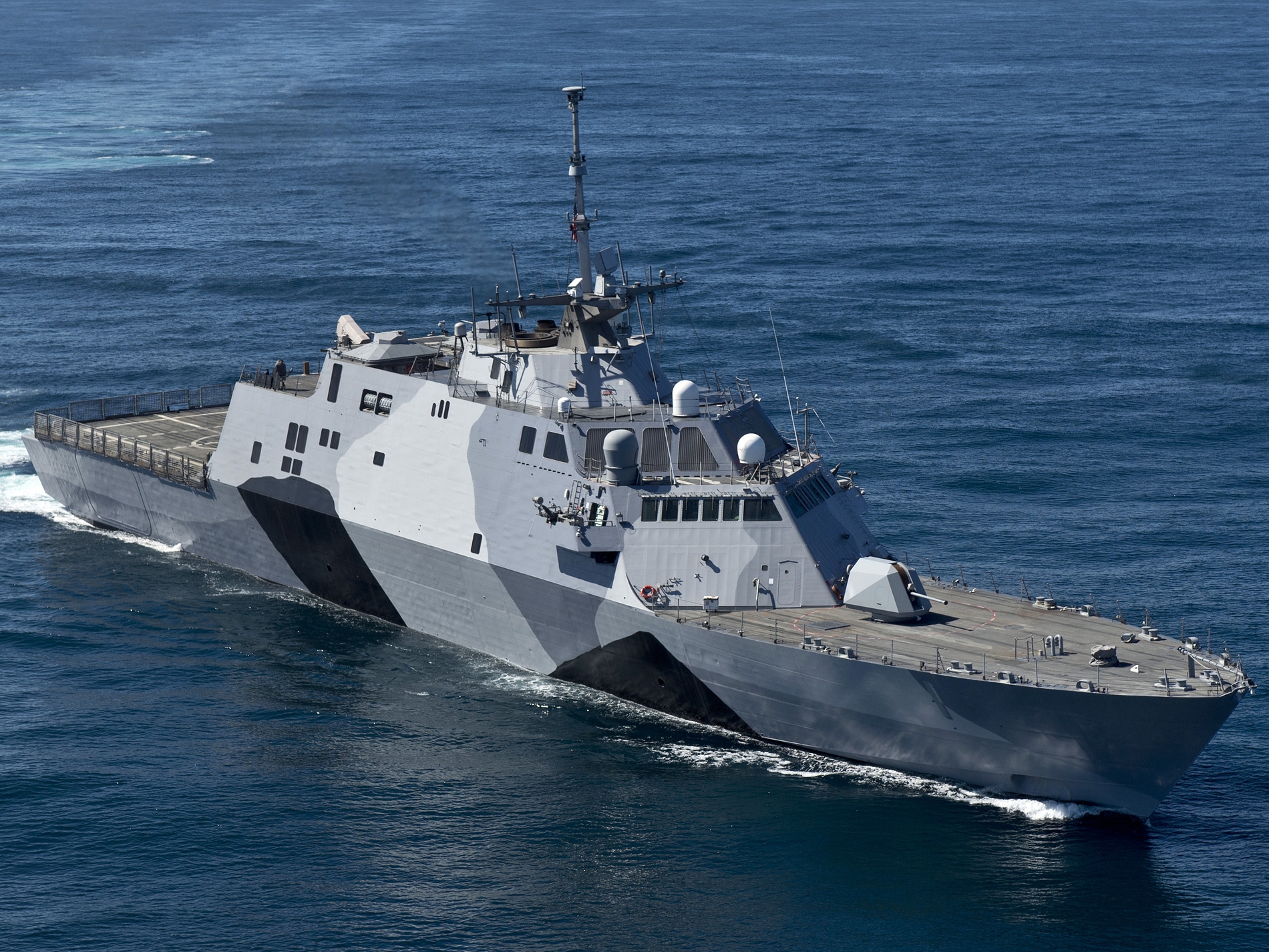
Freedom, Lockheed Martin Corp frigate to Saudi?


Saudi Arabia is in advanced discussions with the U.S. government about buying two frigates based on Freedom a coastal warship [LCS] that Lockheed Martin Corp is building for the U.S. Navy,


September 29 2014 Philippine Bilateral Exercises start near Scarborough Shoal, seized by Chinese]


Joint air and marine exercises "Philippine Bilateral Exercises," or Phiblex, of Philippines and U.S marine units began on Sepember 29 near disputed waters in the South China Sea, testing the readiness of the two oldest security allies in the southeast Asian region to respond to any emergency.

China has expanded its territory in the Gaven, Johnson South, Cuarteron and Chigua reefs in the Spratlys, reclaiming land to build islands to assert its claims.

The Philippines has monitored the presence of more than 120 Chinese warships and fishing boats in the Spratlys in the first half of 2014, establishing firm control over disputed areas.

China seized control of Scarborough Shoal, a rocky outcrop north of the Spratlys, in June 2012 after a three-month standoff with the Philippines, denying Filipino fishermen access to the rich fishing ground.

In the Scarborough Shoal, the Philippines has also reported the presence of an increasing number of ships, from 11 in the last quarter of 2013 to 34 in the first quarter this year.Two U.S. amphibious ships, USS Peleliu and USS Germantown, are participating in the exercises. Besides simulating boat raids and beach assaults, they will feature aerial live fire, mechanized armor maneuvers and parachute drops.

Annual war games are being held under the 1951 Mutual Defence Treaty (MDT), part of a web of security alliances the United States built in the Asia-Pacific region during the Cold War.


[April 5 2013 USS Freedom: LCS bound for Singapore, nothing to do with North Korea]

  The U.S.’ littoral combat ship USS Freedom is en-route to Singapore for temporary deployment as part of the country’s recent military shift toward Asia. Such a shift can further strain relations with China, which is in territorial dispute with its neighbors. A brand new class of ship the USS Freedom is one of just two littoral class combat ships of the U.S. Navy and it pulled into Guam's waters this morning to dock at the Apra harbor. The USS Freedom carries with it two smaller boats that it can launch from two doors in it's rear or aft. These boats carry special interdiction teams trained to board vessels. Commander Timothy Wilke says it's deployment has nothing to do with recent threats from North Korea.


Before it can do that however, the $670 million ship has to get there. The USS Freedom has suffered three blackouts so far in its transit between Hawaii and Guam. As reported by Aviation WeekThe most recent two this week — including one March 21 — brings the outage total to three, all during the ship’s transit from Pearl Harbor to Guam en route to Singapore, says U.S. Pacific Fleet spokesman Darryn James. The outage problems appear to be similar to those the ship suffered during a deployment in the Atlantic when the vessel was first pressed into Navy service, a source intimately familiar with Freedom operations says.
Other than not being able to keep the lights on, the guns on the USS Freedom are also reported not to work properly, and her helicopter is too small to perform mine-sweeping. Additionally  the Navy has admitted in a recent report that the “LCS is not expected to be survivable…” in combat. 

[March 4 2011]


Northrop Grumman-built MQ-8B Fire Scout vertical takeoff and landing tactical unmanned aerial vehicle (VTUAV) flew its first test flights from the U.S. Navy's littoral combat ship, USS Freedom (LCS-1).
The U.S. Navy in the last week of 2010 awarded contracts to industry teams led by Lockheed Martin and General Dynamics to build one Littoral Combat Ship (LCS) with options for nine more over the next five years, as well as technical data packages and support services. Total value of the Lockheed Martin award is $491.9 million; the General Dynamics team contract is for $465.4 million. Saudi Arabia has expressed an interest in Freedom Class vessel, LCS-I
Suppression of enemy air defense for a no-fly zone is done with strike fighters or bombers. This means that any sort of no-fly-zone will have to be enforced by NATO allies, most likely England, France and Italy. There haven’t been any talks about increasing the number of ships near Libya but rather there have been discussions about repositioning naval assets already there. On March 8 that there were no plans to move the carrier Enterprise now in the Red Sea, around a day-long cruise from the Mediterranean. 

 [April 5 2013]U.S.Navy F/A-18 Warplanes have been sent To Philippines For Military Drills. "There will be table top exercises on how the militaries of the two countries would respond to a destructive typhoon as well as in the event of a major ship collision on the high seas," Garcia said, adding the combat aspect would showcase the capability of the U.S. Navy's multi-role fighters The F/A-18 Hornet, an all-weather aircraft, is used as an attack aircraft as well as a fighter. In its fighter mode, the F/A-18 is used primarily as a fighter escort and for fleet air defense; in its attack mode, it is used for force projection, interdiction and close and deep air support. The presence of the warplanes is not connected to tensions on the Korean peninsula, a Philippine army spokesman said.

6.6.14

Amid Chinese oil rig row, Cinese sinks Vietnam boat

[May 19]


Displacement: 5,850 tons standard[1]
6,500 tons full load
Length: 155 m
Beam: 17 m
Draught: 6 m
Propulsion: CODOG 57,000 shp
Speed: 30 knots
Complement: 280
Armament: 16 YJ-83 anti-ship missiles
48 SA-N-12 Grizzly surface-to-air missiles
1× Type 210 100 mm dual purpose gun
2 Type 730 CIWS
2 anti-submarine mortars
6 torpedo tubes
Aircraft carried: 1 helicopter: Kamov Ka-27
Aviation facilities: Single helicopter hangar

[May 10]

Heavy lift Rolldock Star with the HQ-183 Ho Chi Minh City City submarine on board entered Cam Ranh Bay on March 19, 2014.


Submarine. Kilo Class shipped to China

 The submarine has a load of 2,300 tons and can carry a crew of 57. It can operate at a maximum depth of 300 meters at a range of 6,000-7,500 nautical miles for 45 days and nights. The vessel is armed with a Klub-S cruise missile system with 3M-54E1 missiles bearing 450-kg warheads that have a firing range of 220 km. It also has a system of eight Strela-3 anti-aircraft missiles with a firing range of 6 km, six torpedo tubes, and other advanced military equipment.

 China itself has adopted a strategy of building up a submarine force to counter a superior surface opponent (the US Navy). It’s entirely logical for Vietnam to adopt a similar approach vis-a-vis China, especially given that China’s lifeline of raw materials and exported goods from and to Africa, the Middle East, Europe, and parts of Asia passes right by Vietnam’s doorstep. Aside from Thyssen Krupp Marine’s U209 family of submarines, the Russian Kilo Class are the world’s most widely exported subs. They’re known for a level of quietness that’s significantly better than other Russian designs, and have been produced in the Project 877EKM, and the Project 636M “Improved Kilo” / Varshavyanka Class variant that Vietnam is receiving. Countries operating or ordering these submarines include Russia, Algeria, China, India, Iran, Poland, and Romania. Vietnam appears to have opted for a longer-range, higher capacity 3,000t submarine. 

 [April 27]


Promenaders watch the docked amphibious assault ship USS Essex embark from Subic Bay in October 2006


Local leaders and business people in Subic Bay confirm that both Philippine and American defense officials have been there recently to examine the options.

Under the terms of the new defense pact due to be signed April28, the U.S. is only allowed “rotational” access to existing Philippine facilities and cannot run its own bases. That means the Philippines will have to set up new facilities at Subic before the Americans can come in.


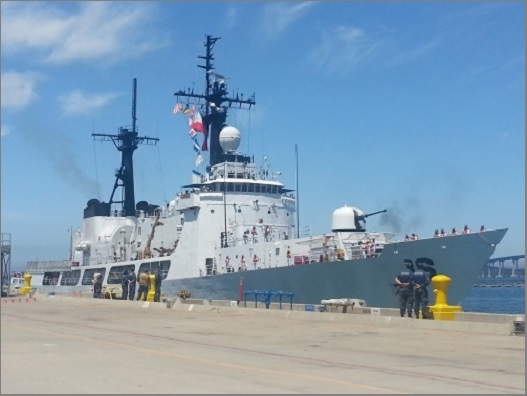
BRP Ramon Alcaraz


The frigate, BRP Ramon Alcaraz, sailed into the Philippines' Subic Bay, a former U.S. naval base.
BRP del Pilar was the country’s first Hamilton-class weather high endurance cutter (WHEC) acquired from the United States, in 2011. It will be used to patrol areas of the South China Sea near the Philippine coast that have become a major source of tension with Beijing.   The Philippines received the latest cutter for free under Washington's foreign military financing program, but spent about $15 million to upgrade its weapons and radar systems.   Hamilton-class ships have the basic modern technology the Philippine Navy needs to train its personnel, and has the size to install current and future weapons and sensors to keep it up-to-date for another decade.
Despite the removal by the US of its original radar systems, the PF-15 has new navigation and surface search radar and a new C&C/Common Operational Picture system. It also has a helicopter hangar and helideck for shipborne helicopter operations, and provisions for new radar and communications systems if the PN decides to install, provisions are also available to upgrade and up-arm the Hamilton-class ships.

The armed forces plan to buy radars, surveillance planes, fighters, and helicopters under the $1.7-billion plan.

Manila has opened talks to acquire a dozen new fighter jets and two frigates from South Korea. It has also ordered 10 coast guard ships from Japan and three more vessels from France.

He said the Hamilton-class ship will be deployed to Palawan and then to the Spratly Islands.

“It is to protect our interest in the natural resources operations that we have, more (specifically) in Malampaya…It is near Spratlys but basically, the objective is to protect our Malampaya (natural gas project)," he said.   the Navy would need to acquire “as many large-hull warships it can possibly get with its limited budget,” to show its presence and patrol the vast areas within the exclusive economic zone (EEZ).

28.2.14

SSV-175 Viktor Leonov (ex Odograf 1988 Northern Fleet) in Cuba

SSV-175 Viktor Leonov 


SSV-175 Viktor Leonov (ex Odograf 1988 Northern Fleet)
Type: Intelligence collection ship 
Displacement: 3,470 tons full load
 Length: 94.4 m Beam: 14.6 m Draught: 4.5 m Propulsion: 2 shafts, 
2 Sulzer diesels, 4,400 bhp Speed: 16 knots Complement: 146 (= 6 passengers) 
Sensors and processing systems: 
Sonar: Pamyat hull mounted arrays, HF dipping Electronic warfare & decoys: 
Intercept arrays 
Armament: 
 2 × AK-630 six-barreled Gatling 30 mm/L60 guns 
2 x SA-N-8 surface-to-air missiles


[2013]
USS Cowpens{CG 63)


Chinese Foreign Ministry spokeswoman Hua Chunying said Kerry and Japanese Prime Minister Shinzo Abe, who has been equally critical of the air Defense zone, should stop harping on the issue. "The show the relevant parties have put on is enough. They should give it a rest. If they really care about this region's peace, they should ... stop fomenting trouble," China's official news agency Xinhua, in an English language commentary, accused the U.S. ship of deliberately provocative behavior. "On December 5, U.S. missile cruiser Cowpens, despite warnings from China's aircraft carrier task group, broke into the Chinese navy's drilling waters in the South China Sea, and almost collided with a Chinese warship nearby," it said. "Even before the navy training, Chinese maritime authorities have posted a navigation notice on their website, and the U.S. warship, which should have had knowledge of what the Chinese were doing there, intentionally carried on with its surveillance of China's Liaoning aircraft carrier and triggered the confrontation."
[December 17]
A day after the United States gave $32.5 million to stiffen maritime security in South East Asia, the bulk of it for Vietnam, Kerry said the United States would provide $40 million to the Philippines over three years to build its capacity to police the South China Sea. "We don't view the situation as one of rising tensions and we don't want rising tensions," Kerry told a news conference with his Philippine counterpart Albert del Rosario. "What we are involved in are normal processes by which we work with other countries in order to raise their maritime protection capacity."

[December 16]

"Bad guys always claim innocence first," a Chinese source that was familiar with this confrontation, told the Global Times on Sunday, adding that the American missile cruiser had entered within 45 kilometers of the inner defense layer of the Chinese fleet that day. 

"The USS Cowpens was tailing after and harassing the Liaoning formation. It took offensive actions at first towards the Liaoning formation on the day of the confrontation," said the source.

It is a fact that China has already announced three regions in the South China Sea as its military areas. The outside world knows that they are used for scientific research and training of the Liaoning aircraft carrier. Meanwhile, many areas in the South China Sea are China's exclusive economic zones. Clearly, the US missile cruiser has come to China's threshold and posed a threat to China's military security, says An official Chinese newspaper

  U.S. Secretary of State John Kerry announced December 16 that the United States will boost maritime security assistance to the countries of Southeast Asia amid rising tensions with Beijing.

On his first visit to Vietnam as America's top diplomat, Kerry pledged an additional $32.5 million for members of the Association of Southeast Asian Nations to protect their territorial waters and navigational freedom in the South China Sea, China's new East China Sea air defense zone, saying it "clearly increases the risk of a dangerous miscalculation or an accident" that could lead to possible conflict between China and Japan over a string of small islands that each claim as their own.

The United States is "very concerned about recent actions that have increased tensions between China and Japan and we call for intensified negotiations and diplomatic initiatives.

"The zone should not be implemented, and China should refrain from taking similar unilateral actions elsewhere, particularly in the South China Sea,"


[December 14]
On December 5, 2013, USS Cowpens, (CG 63) was involved in a minor confrontation with a small Chinese warship that was escorting the Chinese aircraft carrier Liaoning while operating in International waters in the South China Sea. The Chinese amphibious dock ship [Jinggang Shan (999 /井冈山) Type 071 Yuzhao class amphibious transport dock (LPD)?] crossed directly in front of the Cowpens and then halted. The two vessels were barely 500 yards away when the captain of Cowpens ordered "all stop".

The US Navy said that the USS Cowpens, (CG 63) a guided-missile cruiser, had been forced to take evasive action to avoid a collision with a ship from the People’s Liberation Army Navy on December 5. Another U.S. military official said that the incident was ultimately resolved through ship-to-ship communications via radio between the Cowpens and a Chinese aircraft carrier in the vicinity. The official said that at some point there was direct communication between the Cowpens and the Chinese vessel that was harassing it, but the official was unaware of what was said during the exchange.

[{December 6]


But China’s declaration of the expanded air control zone highlighted a potentially volatile dispute between China and South Korea, since it covered Ieodo, a submerged reef south of Jeju, an island off the south coast of South Korea. Ieodo, which South Korea says it effectively controls, is believed to be surrounded by natural gas and minerals deposits.


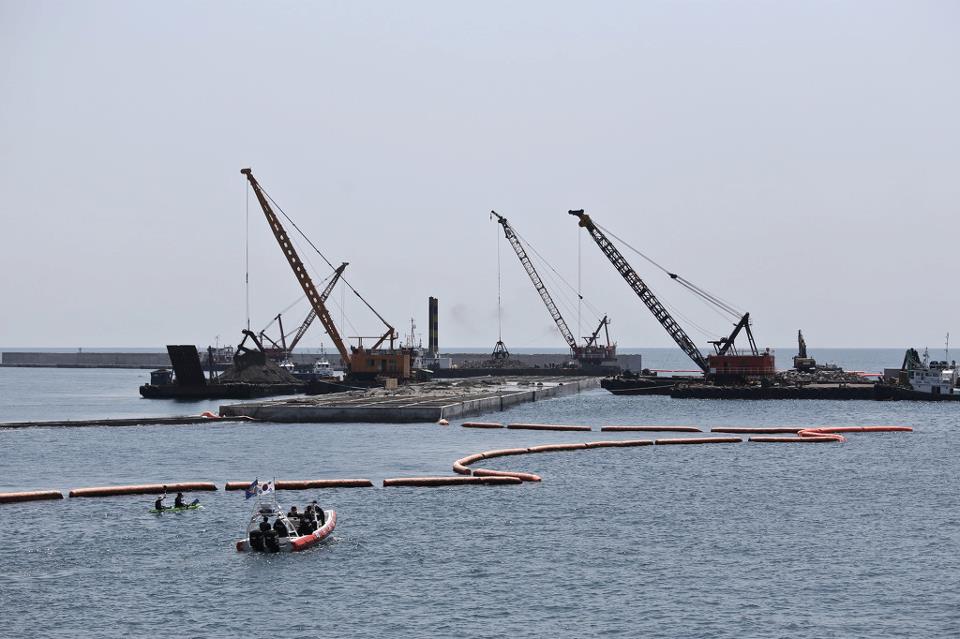
Despite fierce protests from environmentalists, South Korea is building a $970 million naval base in Jeju, a home for 20 warships, including submarines, that the navy says will protect shipping lanes in the East China Sea for South Korea’s oil-dependent, export-driven economy as well as enabling it to respond quickly to any dispute with China over the rock.


Under international maritime law, countries cannot claim a submerged rock as territory but can claim the right to control and use waters and natural resources around it. Both China and South Korea claim such rights over the reef. Currently, the Korea Hydrographic and Oceanographic Administration manages a research station built on the rock. The partial demolition of the 1.2 kilometer-long rock formation is scheduled to take place over the following three months.


The Jeju Naval Base (Hangul: 제주 해군기지; Hanja:濟州海軍基地) is a planned military base on Jeju Island, South Korea (coterminous with Jeju Province, or Jeju-do).


;April 12 2013]

Korean media said Han Jun deploy two Aegis-class warships to monitor North Korean missile.   Yonhap quoted South Korean military sources as saying, in response to the possibility of North Korea launched a medium-range missiles, South Korean military has deployed in waters near two equipped with radar Aegis destroyers used to monitor and t rack.

The source said the two 7,600-ton Aegis destroyers were deployed in Korean waters east and west sides standby, two warships are equipped with a detection range of 1,000 kilometers of the SPY-1 radar if North Korea launched a missile can be rail track.