Showing posts with label Liaoning. Show all posts

18.10.15

Liaoning: generally considered by military experts to be a training carrier

Oct 14, 2015    Foreign Ministry spokeswoman Hua Chunying, when asked if China had or would send forces to Syria, told a daily news briefing that she had also noticed the reports.
"I can tell you that as for China's warships, for example the Liaoning, whether it has gone to join, for this issue, as far as I know, there is no such plan. At this time the Liaoning is in a phase of carrying out technical training and military exercises."   The Liaoning is generally considered by military experts to be a training carrier, while China builds its own carriers and works out how to operate them.


[February 2 
 The authority in Changzhou, in eastern Jiangshu province, boasted on social media on February 1 that a local firm had won a contract to supply electrical cabling for  China's second aircraft carrier.   It later deleted the post, but not before it had been widely circulated. 

[July 4 2013 Shi Lang Varyag: now  Liaoning, F-5 takes off]

Photo shows a J-15, China's first-generation multi-purpose carrier-borne fighter jet, taking off from the deck of the Liaoning, China's first aircraft carrier, on June 29, 2013.   Jane's Fighting Ships had previously stated that the ship would be named Shi Lang and assigned pennant number 83 but at the commissioning ceremony, the carrier was officially named Liaoning.


[September 25 2012]
China's first aircraft carrier was delivered to the Chinese Navy at the port of Dalian on September 23, 2012. The carrier, built on former Ukrainian vessel Varyag, is capable of carrying around 30 fixed wing fighters and helicopters and a crew of about 2,000. And the hull number, "16," has been painted on the ship recently. [earlier]China has renovated the Varyag, an incomplete Kuznetsov-class aircraft carrier purchased from Ukraine, and carried out the first trial navigation in August 2011. China seems to be advancing training of carrier-based aircraft pilots and development of the J-15, a carrier-based fighter. In addition, it has constructed a structure on land which replicates an aircraft carrier and is developing an airfield for take-off and landing training. Based on these facts, it is believed that China is now earnestly advancing research and development on technologies necessary for possession of aircraft carriers. 
In view of these developments in the modernization of the Chinese Navy, it is believed that China is trying to build capabilities to conduct operations in more distant areas. 

In recent years, when environment surrounding military has greatly been changing including advancement in military specialization and diversification of missions according to the modernization of military, some see that relations between the CCP leadership and the People's Liberation Army (PLA) has been getting complex and others see that the degree of military influence on foreign policy decisions has been changing13. The situation attracts attention as a risk management issue too. Japan, Defense White paper, July, 2012


[6/8/11]The carrier was constructed in the 1980s for the Soviet navy but was never completed. When the Soviet Union collapsed, the rusting hull of the Varyag sat in dockyards in Ukraine.
A small Hong Kong company called the Chong Lot Travel Agency Ltd.it said wanted to turn it into a floating casino in Macau and purchased it at auction for US$20 million. The total cost of acquiring the hulk was over $30 million USD: $25 million to the Ukrainian government for the hull, nearly $500,000 in transit fees, and some $5 million for the towing.
The head of China's General Staff of the People's Liberation Army (PLA) has confirmed that China's first aircraft carrier is under construction.
In fact, China faces severe ocean threats, Qi Jianguo, Assistant Chief of General Staff, says, China is now in the oceans are facing the pressure of several directions, to see how the situation changes. You see, now that the sea, the island chain, the South China Sea issue, the Taiwan Strait issue, the East China Sea issue, the question the Yellow Sea, the world can there be a large country like China is facing such a complex marine problems?" Hong Kong Commercial Daily

Gen Chen Bingde refused to say when the carrier - a remodelled Soviet-era vessel, the Varyag - would be ready.

28.2.14

SSV-175 Viktor Leonov (ex Odograf 1988 Northern Fleet) in Cuba

SSV-175 Viktor Leonov 


SSV-175 Viktor Leonov (ex Odograf 1988 Northern Fleet)
Type: Intelligence collection ship 
Displacement: 3,470 tons full load
 Length: 94.4 m Beam: 14.6 m Draught: 4.5 m Propulsion: 2 shafts, 
2 Sulzer diesels, 4,400 bhp Speed: 16 knots Complement: 146 (= 6 passengers) 
Sensors and processing systems: 
Sonar: Pamyat hull mounted arrays, HF dipping Electronic warfare & decoys: 
Intercept arrays 
Armament: 
 2 × AK-630 six-barreled Gatling 30 mm/L60 guns 
2 x SA-N-8 surface-to-air missiles


[2013]
USS Cowpens{CG 63)


Chinese Foreign Ministry spokeswoman Hua Chunying said Kerry and Japanese Prime Minister Shinzo Abe, who has been equally critical of the air Defense zone, should stop harping on the issue. "The show the relevant parties have put on is enough. They should give it a rest. If they really care about this region's peace, they should ... stop fomenting trouble," China's official news agency Xinhua, in an English language commentary, accused the U.S. ship of deliberately provocative behavior. "On December 5, U.S. missile cruiser Cowpens, despite warnings from China's aircraft carrier task group, broke into the Chinese navy's drilling waters in the South China Sea, and almost collided with a Chinese warship nearby," it said. "Even before the navy training, Chinese maritime authorities have posted a navigation notice on their website, and the U.S. warship, which should have had knowledge of what the Chinese were doing there, intentionally carried on with its surveillance of China's Liaoning aircraft carrier and triggered the confrontation."
[December 17]
A day after the United States gave $32.5 million to stiffen maritime security in South East Asia, the bulk of it for Vietnam, Kerry said the United States would provide $40 million to the Philippines over three years to build its capacity to police the South China Sea. "We don't view the situation as one of rising tensions and we don't want rising tensions," Kerry told a news conference with his Philippine counterpart Albert del Rosario. "What we are involved in are normal processes by which we work with other countries in order to raise their maritime protection capacity."

[December 16]

"Bad guys always claim innocence first," a Chinese source that was familiar with this confrontation, told the Global Times on Sunday, adding that the American missile cruiser had entered within 45 kilometers of the inner defense layer of the Chinese fleet that day. 

"The USS Cowpens was tailing after and harassing the Liaoning formation. It took offensive actions at first towards the Liaoning formation on the day of the confrontation," said the source.

It is a fact that China has already announced three regions in the South China Sea as its military areas. The outside world knows that they are used for scientific research and training of the Liaoning aircraft carrier. Meanwhile, many areas in the South China Sea are China's exclusive economic zones. Clearly, the US missile cruiser has come to China's threshold and posed a threat to China's military security, says An official Chinese newspaper

  U.S. Secretary of State John Kerry announced December 16 that the United States will boost maritime security assistance to the countries of Southeast Asia amid rising tensions with Beijing.

On his first visit to Vietnam as America's top diplomat, Kerry pledged an additional $32.5 million for members of the Association of Southeast Asian Nations to protect their territorial waters and navigational freedom in the South China Sea, China's new East China Sea air defense zone, saying it "clearly increases the risk of a dangerous miscalculation or an accident" that could lead to possible conflict between China and Japan over a string of small islands that each claim as their own.

The United States is "very concerned about recent actions that have increased tensions between China and Japan and we call for intensified negotiations and diplomatic initiatives.

"The zone should not be implemented, and China should refrain from taking similar unilateral actions elsewhere, particularly in the South China Sea,"


[December 14]
On December 5, 2013, USS Cowpens, (CG 63) was involved in a minor confrontation with a small Chinese warship that was escorting the Chinese aircraft carrier Liaoning while operating in International waters in the South China Sea. The Chinese amphibious dock ship [Jinggang Shan (999 /井冈山) Type 071 Yuzhao class amphibious transport dock (LPD)?] crossed directly in front of the Cowpens and then halted. The two vessels were barely 500 yards away when the captain of Cowpens ordered "all stop".

The US Navy said that the USS Cowpens, (CG 63) a guided-missile cruiser, had been forced to take evasive action to avoid a collision with a ship from the People’s Liberation Army Navy on December 5. Another U.S. military official said that the incident was ultimately resolved through ship-to-ship communications via radio between the Cowpens and a Chinese aircraft carrier in the vicinity. The official said that at some point there was direct communication between the Cowpens and the Chinese vessel that was harassing it, but the official was unaware of what was said during the exchange.

[{December 6]


But China’s declaration of the expanded air control zone highlighted a potentially volatile dispute between China and South Korea, since it covered Ieodo, a submerged reef south of Jeju, an island off the south coast of South Korea. Ieodo, which South Korea says it effectively controls, is believed to be surrounded by natural gas and minerals deposits.


Despite fierce protests from environmentalists, South Korea is building a $970 million naval base in Jeju, a home for 20 warships, including submarines, that the navy says will protect shipping lanes in the East China Sea for South Korea’s oil-dependent, export-driven economy as well as enabling it to respond quickly to any dispute with China over the rock.


Under international maritime law, countries cannot claim a submerged rock as territory but can claim the right to control and use waters and natural resources around it. Both China and South Korea claim such rights over the reef. Currently, the Korea Hydrographic and Oceanographic Administration manages a research station built on the rock. The partial demolition of the 1.2 kilometer-long rock formation is scheduled to take place over the following three months.


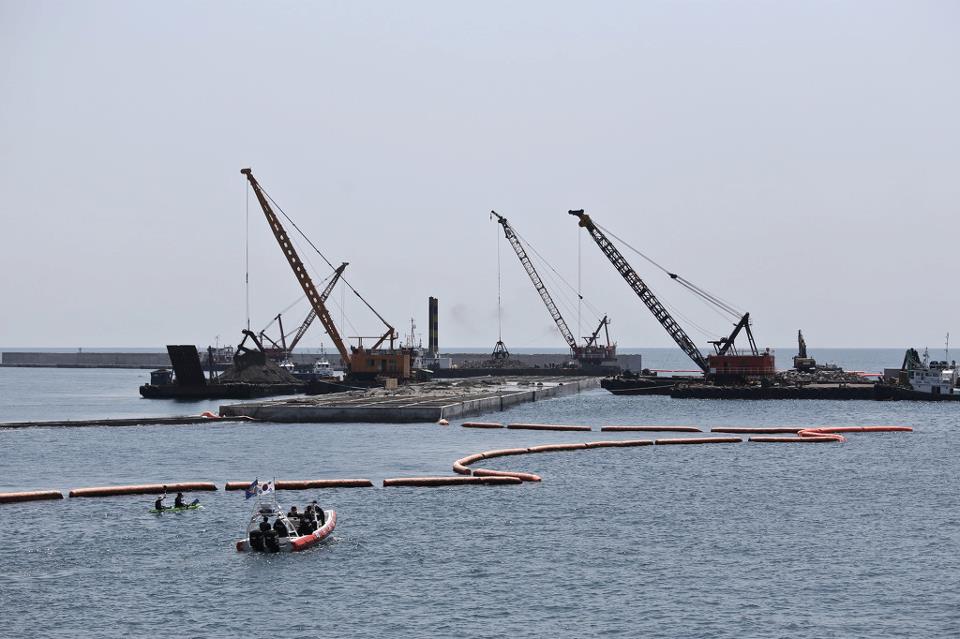
The Jeju Naval Base (Hangul: 제주 해군기지; Hanja:濟州海軍基地) is a planned military base on Jeju Island, South Korea (coterminous with Jeju Province, or Jeju-do).


;April 12 2013]

Korean media said Han Jun deploy two Aegis-class warships to monitor North Korean missile.   Yonhap quoted South Korean military sources as saying, in response to the possibility of North Korea launched a medium-range missiles, South Korean military has deployed in waters near two equipped with radar Aegis destroyers used to monitor and t rack.

The source said the two 7,600-ton Aegis destroyers were deployed in Korean waters east and west sides standby, two warships are equipped with a detection range of 1,000 kilometers of the SPY-1 radar if North Korea launched a missile can be rail track.