Popular Posts

Showing posts with label suezmax. Show all posts

14.11.15

Tankers sail in figure eights

reported tanker locations

Not everyone associated with the oil industry is losing these days. As the enormous ships sail in figure eights around the globe, the tanker companies are reaping the rewards, making as much as $70,000 a day, if not more, for their services.
 Such is the state of the oil industry these days that there is sometimes nowhere to put the oil. Off the coast of Texas, a line of roughly 40 tankers has formed, waiting to unload their crude or, in some cases, for a willing buyer to come along. Similar scenes are playing out off the coasts of Singapore and China and in the Persian Gulf.

[June 5 floating storage: low crude steep contango]
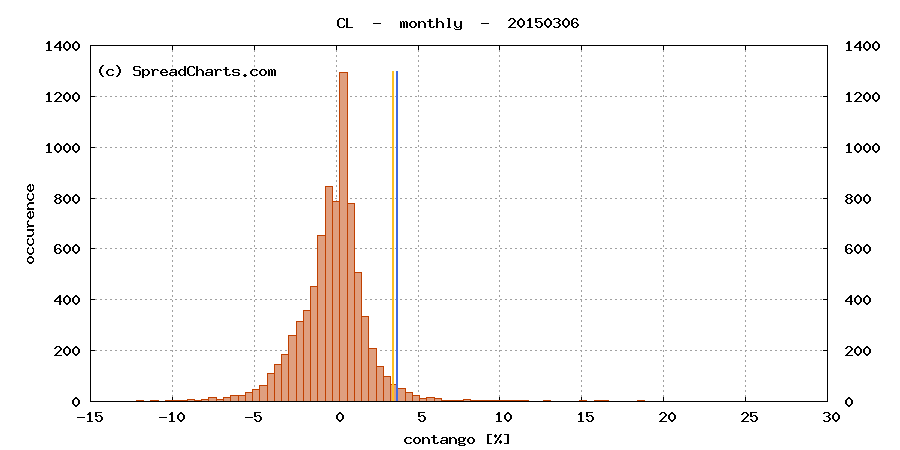
50 million barrels of crude were added to floating storage globally since January,   According to Iranian officials, the country's approximate 50 million barrels stored at sea is mostly condensate and fuel oil, and not crude as some traders fear.   Ccondensate condenses out of the natural  gas if the temperature is reduced to below the hydrocarbon dew point temperature of the raw gas.   Due to the steep contango in the forward curve, the investors best positioned to execute on a long oil trade are those who have the capacity to buy a few thousand barrels of oil, store it in their backyard, and sell it in a few months.  For everyone else, be prepared to pay handsomely for that storage.

[June 5 The fading contango: tankers used for floating storage.freed up as oil unloaded]
Physical oil is coming under pressure as trade houses unwind a profitable storage play after several months that saw them holding millions of barrels on tankers at sea.  Charterers made fresh efforts to get rates below the psychological mark of w60 Worldscale rates for VLCCs on the Persian Gulf to East routes, The key PG-Japan rate was assessed unchanged at w59.. The market is very volatile and if there are one or two replacement or date sensitive cargoes, they push up the rates,


[earlier]


Freight rates for dirty tankers in the East of Suez market have gone up sharply to hit their highest level so far in 2015 lately, amid strong demand to move crude and fuel oil and spike in interest for floating storage.   The long waiting time in Basrah for ships to load and delays in discharging at South Korea and China due to logistics and weather issues also reduced tonnage supply, contributing to firming rates.

[May 13 ]
More VLCCss were being used for storage over the last four – six weeks.   A third of the vessels taken on time charter earlier in the year are now used for floating storage. Most of these are in the Arabian Gulf, but there also some in Singapore, West Africa and the Mediterranean.

[April 24 tankers for crude storage]
Invalid locations?
As much as 90 percent of global oil storage capacity is “captive,” or controlled by major producers such as Royal Dutch Shell Plc, BP Plc or Chevron Corp. That means only a small part of land-based oil storage is available for independent traders to lease to exploit the market contango, which has prevailed since July.


Some of the world’s largest oil traders have moved to secure floating storage in tankers to take advantage of the market contango. Vitol, Koch Industries Inc., Shell and Trafigura Beheer BV, have booked tankers that could be used to store crude at sea for one-year charters, The last time the oil market moved into a significant contango during the global financial crisis of 2008 and 2009, traders stored 100 million barrels at sea.

[December 12 2014 ]
Seaborne oil trade will rise by 3.5 percent in 2015, against no change in the fleet,  83 very large crude carriers were bound for Chinese ports, at about 8:30 a.m. December 12in London. The ships would transport 166 million barrels, assuming standard cargoes, the largest number in data starting in October 2011. The cost of hiring the vessels surged to the highest in almost five years.   Part of the tanker freight-rate rally may be because of rising shipments from West Africa. Traders booked 33 cargoes of crude on VLCCs from the region this month, 43 percent more than a year earlier.

[October 29  Phantom Ships in the Northwest Passage]
To hide their crimes on the high-seas, hundreds of ships broadcast false identities by using transmitters taken from scrapped vessels on the black market and by typing in made-up ID numbers and hoping they don't arouse suspicion.    Fifteen percent of all ships transmitting fake identities are tankers, typically carrying oil or oil products.    Vessels smuggling oil shipments or other raw materials can lead to significant gaps in intelligence on supply and demand.    large shipping companies seeking to maintain market opaqueness, oil tankers circumventing international sanctions, and large oil producers concealing oil via floating storage in order to affect global oil prices. This group will likely be followed by far more ships seeking to conceal their information in the future.

The Northwest Passage is a sea route through the Arctic Ocean, along the northern coast of North America via waterways through the Canadian Arctic Archipelago, connecting the Atlantic and Pacific Oceans.

[May 9 2010 Sitting Ducks for pirates: idling tankers]

At least 15 VLCC crude carriers are idling in the Persian Gulf, Gulf of Oman and Gulf of Suez. The tankers can store a combined 30 million barrels of oil.

Traders store oil hoping to benefit from a so-called contango structure in futures markets, in which prompt prices are lower than contracts for later delivery. Traders can make money when the difference in prices is greater than the cost to charter the ship.

The contango between the front-month crude contract traded on the New York Mercantile Exchange and the second-month contract to the highest level since Dec. 15. Dirty products usually include crude oil and may include fuel oil.

The VLCC rate was $43,876 a day as of April 23, according to the London-based Baltic Exchange. The rate has more than doubled this year. VLCCs can carry about 2 million barrels of oil.


Iran, OPEC’s second-biggest oil producer, added three supertankers to its fleet of vessels storing crude, matching a similar program in 2008 that helped freight rates to triple, ship tracking data show.

Two years ago, Iran used as many as 15 tankers for storage, constricting vessel supply and helping to more than triple freight rates in less than three months.

Iran is likely storing oil because of weakening demand as refineries across Asia, accounting for almost two-thirds of global demand for supertankers, carry out maintenance. National Iranian Tanker Co., which operates the supertankers, also has a laden suezmax tanker idling off Iran, ship-tracking data show. A suezmax can hold about 1 million barrels of oil.

12.2.14

MT Kerala: tale of George Procopiou's recovered product carrier


Pirates disabled the vessel’s AIS and other communication equipment so that the vessel could not be tracked from shore or satellite, painted over the identifying features of the vessel, including funnel, name and IMO number and undertook three separate ship-to-ship transfers of cargo amounting to the theft of approximately 12,271.5mt of cargo.

The owners of the Liberian-flag KERALA regained contact with the vessel on January 26, 2014, shortly after the pirates had disembarked. The vessel then immediately set a course for the safety of the port of Tema, Ghana, as a port of refuge.

A gang of Nigerian pirates reportedly stole a tugboat and sailed south into Angolan waters on January 18, 2014 where they attacked the oil products tanker carrying 60,000 metric tons of diesel, a few miles off the coast of Luanda, the capital of Angola.The Gulf of Guinea, a major commodities route, which covers an immense area extending from the Guinean coast to offshore Angola, has now become a piracy hotspot, where pirates attack oil tankers and other cargo vessels. They seize large oil tankers and load oil onto other ships to sell on the lucrative black market.

[March 3 2013]

Panama-flagged MV Royal Grace, a chemical tanker which was captured on March 2, 2012, and the Greek-owned oil tanker Smyrni, seized on May 11, 2012, are heading to Salalah, Oman.  
Mumbai: Due to coordinated actions of Ministry of Shipping, External Affairs, Defence, Home Affairs, Director General Shipping and other important agencies, on March 8 we could get release of two vessels MV Royal Grace hijacked in March 2012 and MT Smrini hijacked in May 2012. Twenty eight Indian sailors held hostage by Somali pirates have been released. The sailors were on board two ships Merchant Tanker Royal Grace and Merchant Tanker Smyrni and 17 were on board the MT Royal Grace and 11 were on board the MT Smyrni.
The Indian sailors have been released but they are yet to reach a safe zone. Both the ships were hijacked off the coast of Somalia in 2012.
Shipping Minister GK Vasan made the announcement in Chennai, saying the government secured the release of the sailors on board the two vessels due to coordinated efforts of the Ministries of Shipping, External Affairs, Defence, Home Affairs, Director General Shipping and other agencies. "I am very happy to announce the release of Indian seafarers. Due to coordinated actions of Ministry of Shipping, External Affairs, Defence, Home Affairs, Director General Shipping and other important agencies, on Friday we could get release of two vessels MV Royal Grace hijacked in March 2012 and MT Smrini hijacked in May 2012," Vasan told reporters in Chennai.
                After failing to receive help from the Government of India, the families of 17 Indian crew members of the MV Royal Grace sought help of a Pakistani-based activist Ansar Burney.   Burney, who runs the Ansar Burney Trust, was earlier successful in freeing the crew of MV Suez in June 2011, during another hijacking by Somali pirates
[June 5, 2012]


The tanker is near Bargaal. Pirates on board the Smyrni claim they are planning to move south to Garacad area and then onto Harardhere and Hobyo in Galmadug. Or they will move north to the northern tip of Puntland in Qandala or Caluula or south into Galmadug outside the operational area of Puntland. 
The market value of the crude oil loaded in Turkey and destined for refining in eastern Borneo is around $115 million.


George Procopiou 


The Liberian-flagged Tanker, the M/T SMYRNI,Imo 9493779 is carrying a cargo of 135000 MT of crude oil managed by Dynacom Tankers Management Ltd. (with a further 40 vessels in the fleet)  was attacked by 2 pirate skiffs approximately 285nm SSE of Masirah Island, Oman. and  hijacked while it was transiting the Arabian Sea.   No communications have been received from the ship since the ship was boarded.

The attack occurred at 0930 UTC, May 10.


Ship Type: Oil products tanker
Year Built: 2011
Length x Breadth: 275 m X 48 m
Gross Tonnage: 83562, DeadWeight: 149998 t
Speed recorded (Max / Average): 9 / 9 knots
Flag: Liberia [LR] 
Call Sign: A8YB6
IMO: 9493779, MMSI: 636015015 


Owner:Pisces Finance Ltd.
Class Society:American Bureau of ShippingOperator:Pisces Finance Ltd. / Dynacom Tankers Management Ltd.


Pisces Finance II Limited was incorporated in 2002 and is based in Cricket Square, Cayman Islands.
Mr. George Procopiou Founded Dynacom Tankers Management Ltd. and serves as its Chairman of the Board. Mr. Procopiou serves as Director of The North of England Protecting and Indemnity Association Limited.Dynacom Tankers Management, Ltd., a shipping company, operates cargo vessels for the oil industry. It operates a fleet of double hulls, very large crude carriers (VLCC), tankers, and LNG carriers. The company was founded in 1991 and is based in Athens, Greece with additional offices in Bombay and New Delhi, India; Singapore, Singapore; Fujaira, the United Arab Emirates; and a representation in Beijing, China.

94 Vas Georgiou B/2 Nikis Street
Glyfada
Athens,  166 75
Greece
Founded in 1991
George J. Procopiou’s business card states that his title is Civil Engineer. That fits very well with the personal style of Dynacom, a family-operated company in Glyfada, just outside Athens in Greece.

But the impression of a family-owned and -operated shipowner confirms the commitment to shipping and to running a professional company. It is hands-on for Mr Procopiou, whose company will take delivery of no fewer than 21 newbuildings next year. “Running Dynacom is both our business and hobby,” says Procopiou, underlining that it is teamwork that creates success and not a one-man show. Transforming Dynacom from a company operating basically second-hand tonnage into the present-day operator of a young fleet with an ambitious newbuilding programme is quite an achievement, and we are pleased to have an opportunity to learn more about the company from the very engaged George Procopiou, Civil Engineer, who occupies the corner office.“Since 2000, we’ve ordered no fewer than 85 newbuildings, and next year (2009) we will take delivery of another 21 vessels. We have good in-house expertise on newbuildings and on what we should look for when it comes to additions and changes to the yard designs. Normally, when we go through the specifications we end up with some USD 4–6 million in additions. This means that we take delivery of vessels made to our specifications, and the important thing here is that these vessels are as attractive to us as they are to potential users” says Procopiou.

One of the main reasons for Dynacom’s success is the company’s in-depth knowledge of shipping acquired over a long-term period. The company has first-rate operational and technical knowledge of the vessels. “The enthusiasm for what we do in terms of shipping experience and know-how makes our people stay on – we are all very proud of our achievements as we all identify ourselves very strongly with our company. 
The fleet today comprises some 50 vessels – mostly tankers and some LNG carriers,” he says.

Environment
Fuel prices are on the way up, as has been the case for a while. Engine manufacturers must maintain a focus on achieving the best possible fuel consumption and least possible emissions. Slowing down 
vessels to reduce the per mile fuel consumption and consequently emissions is 
of course a quick fix for air pollution issue. It is the engine makers task to design and build engines with lower 
emission levels. 
A longer term solution might be in switching from fuel oil to LNG. 
On the suggestion that larger vessels could be more environment friendly, this is a complex issue as many factors have 
to be in line to enable the use of larger 
vessels, such as port sizes water depth, shore installations. All such topics should be addresses simultaneously and under the spectrum of the global effects on 
pollution and not the regional ones.


LNG 
The move into the highly specialised LNG business, which used to be a rather closed business segment with particularly high standards, confirms Dynagas’s commitment to shipping and energy transportation and it achieved due to the company’s high standards and knowledge. “The age of our LNG vessels is less then two years The LNG market is soft for the time being, but I strongly believe that this will change over time. Two main reasons for this are that using coal for power production is not all that environmentally acceptable in many countries and, with the soaring prices for oil products, power production based on oil will have to be reduced. In many countries, nuclear power is either banned or has a bad public image. That leaves natural gas, as it is much more environmentally friendly with lower levels of CO2 emissions and almost no SOx and NOx emissions. Some projects have been delayed as the LNG production facilities either have not been finished in time or are experiencing technical problems. But the orders for ships are there and right now there are too many vessels waiting