Showing posts with label Persian Gulf. Show all posts

9.4.12

Enterprise: largest US Navy ship to Gulf

The U.S. Navy said April 9, it has deployed a second aircraft carrier to the Persian Gulf region amid rising tensions with Iran over its nuclear program. The deployment of the nuclear-powered USS Enterprise [CVN 65] along the Abraham Lincoln [CVN 72] carrier strike group marks only the fourth time in the past decade that the Navy has had two aircraft carriers operating at the same time in the Persian Gulf and the Arabian Sea, It is the final deployment for the Enterprise, which is currently with the U.S. Navy’s 5th and 6th Fleet areas of operation as an ongoing rotation of U.S. Forces supporting maritime security operations in international waters around the world. The Enterprise Carrier Strike Group consists of about 5,500 sailors and marines. The Enterprise was commissioned in November 1961. The carrier is scheduled to be deactivated this fall. Enterprise is the oldest and largest active combat vessel in the Navy.
April 8, 2012 aboard USS Makin Island LHD-8, Wasp-class amphibious assault ship, The purpose/mission of Makin Island is to embark, deploy, and land elements of a Marine landing force in an Amphibious Assault by helicopters, landing craft, and amphibious vehicles. Now in Fifth Fleet area with 11th Marine Expeditionary Unit

29.3.12

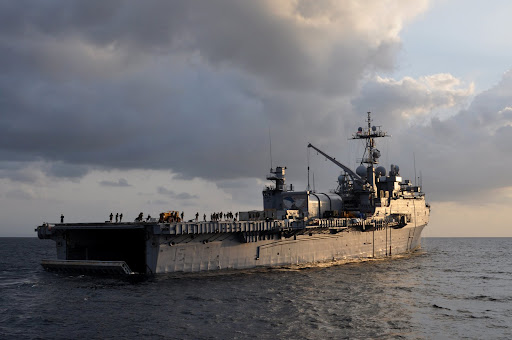
USS Ponce (LPD-15) : Afloat Forward Staging Base

"We are moving four more mine sweeps to the theater," [Adm. Jonathan Greenert, chief of naval operations, told the Senate Armed Services Committee earlier this month]. "That'll make eight. We are moving airborne mine countermeasure helicopters. That'll take us to eight in theater. And ... those, working with the British mine sweeps there, which we exercise with frequently, sets us up a little bit there."
Each of the ships - the USS Sentry (MCM 3), USS Devastator (MCM 6), USS Pioneer (MCM 9) and USS Warrior (MCM 10) - carries a crew of about 60. All are equipped to detect and neutralize mines.
The Navy this month also sent to the region four additional MH-53 Sea Dragon helicopters, which also have the capability to locate and destroy mines.
The Navy will also be sending the USS Ponce (LPD-15) to the region in the next few months to act as a floating staging base. Manned by a military and civilian crew, the vessel will provide refueling, resupply and maintenance operations for minesweepers, aircraft and patrol craft at sea in the region
The retrofit will transform the long-serving amphibious transport dock ship into an Afloat Forward Staging Base (AFSB-I) with a habitability structure to support a combined Navy/civil service mariner crew. Slated for deployment this summer, the modernized Ponce will provide maritime mobility, support and refueling capabilities in the U.S. Central Command Theater, an area that includes the Middle East, North Africa and Central Asia.
[January 27]Lt. Cmdr. Mike Kafka, a spokesman for the Navy’s Fleet Forces Command, declined to elaborate on the floating base’s purpose or to say where, exactly, it will be deployed in the Middle East. Other Navy officials acknowledged that they were moving with unusual haste to complete the conversion and send the mothership to the region by early summer.

5.7.11

USN Ship used for suspected terrorist

Somali Pirate questioned aboard USNS Lewis and Clark earlier


Warsame was turned over to the FBI after extensive "humane" interrogation aboard ship by a unit known as a High-Value Interrogation Group, made up of FBI, CIA and Defense Department personnel, the officials said. But a U.S. official said CIA officers did not directly question Warsame. After the controversy surrounding George W. Bush-era interrogations of detainees, the CIA has consistently said it has kept its agents away from direct questioning.

Adm. William H. McRaven, who is taking over as head of U.S. Special Operations Command, was asked last week during his confirmation hearings what the U.S. did with militants captured outside Afghanistan.

"In many cases, we will put them on a naval vessel and we will hold them until we can either get a case to prosecute them in U.S. court," send them to a third country or release them, McRaven said, without providing specifics. Shipboard detentions had been alleged by human rights groups but never confirmed.

11.1.08

No Iranian Fast Boat Radio Threat, Pentagon

1981 graduate of the U.S. Naval AcademyThe communication Sunday was made on radio channel 16, a common marine frequency used by ships and others in the region. "It could have been a threat aimed at some other nation or a myriad of other things," said Rear Adm. Frank Thorp IV, a spokesman for the Navy. Robin Wright

8.1.08

USN about three miles outside Iran's territorial waters


"It is a basic responsibility of patrolling units of the Revolutionary Guards to take necessary interception measures toward any vessels entering into the waters of the Persian Gulf,"senior Revolutionary Guards commander Ali Reza Tangsiri said, according to the Mehr news agency. here My feeling is, just blast the hell out of them,”naval analyst Norman Polmar said. “You attack a (U.S. Navy) destroyer or a cruiser, you can expect to get killed.” here

7.1.08

Straits of Hormuz Revolutionary Guards


Five Iranian Revolutionary Guard fast boats "harassed and provoked" three U.S. naval ships in international waters at the Straits of Hormuz at the mouth of the Persian Gulf. The cruiser Port Royal, the destroyer Hopper and the frigate Ingraham were in international waters on their way into the Persian Gulf around 8 a.m. local time Sunday when the Iranian encounter occurred. Vice Adm. Kevin J. Cosgriff, commander of American naval forces in the region, said Iran might take actions to illustrate its ability to damage global prosperity. The Fars news agency, which is close to the Revolutionary Guard, wrote “This was a media show by Bush to pretend his trip is important to the Middle East and to make the Arab countries feel that they need the U.S. forces in the region for security.” here