Showing posts with label Arkhangelsk. Show all posts

7.4.15

Oscar-II cruise missile Russian sub 949 Antei fire out

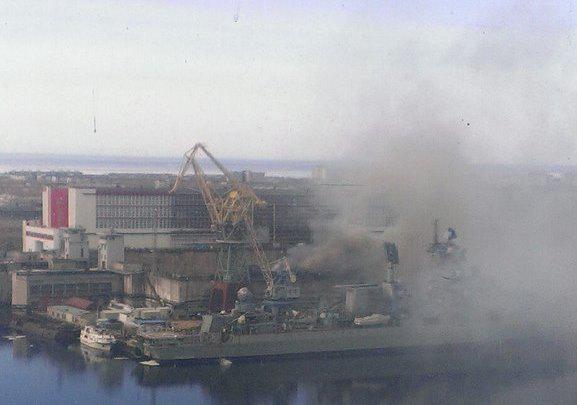
 Firefighters have put out a blaze on a nuclear submarine,  the state-owned United Shipbuilding Corporation which runs the Zvyozdochka shipyard said

smoke rising above a dock at the Zvyozdochka shipyard in the north Russian city of Severodvinsk, April 7, 2015


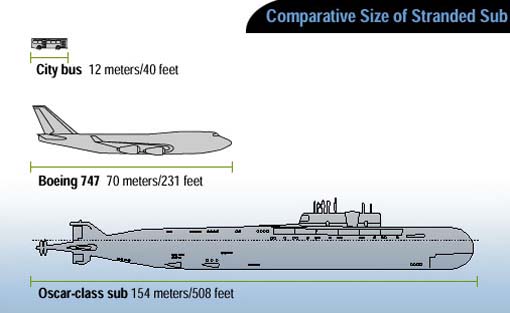
07 Apr 2015  A Russian nuclear submarine has caught fire in a shipyard in Russia's northern province of Arkhangelsk,    The Emergencies Ministry declined comment on the reports of the fire at the Zvyozdochka shipyard, where the agencies said the 500-metre-long 949 Antei submarine was being repaired. There was no word of any casualties.   A source told TASS news agency the submarine's nuclear reactor had been shut down prior to the blaze.   "The active zone of the reactor was unloaded at the start of repairs a few years ago," the source said.   The news agency reports said the fire had started during welding, causing insulation materials to catch fire.

A similar blaze in 2011 nearly led to a nuclear disaster as a blaze engulfed a nuclear-powered submarine carrying atomic weapons, a leading Russian magazine reported months after the blaze, contradicting official assurances that it was not armed.
Project 949 (Granit) and Project 949A (Antey) are Soviet Navy/Russian Navy cruise missile submarines (NATO reporting names: Oscar-I and Oscar-II respectively).  In the late 1990s it completed several new submarines of the third generation Oscar II     Two Oscar II submarines are active with the Northern Fleet and five with the Pacific Fleet.
THE KURSK DISASTER
On 12 August 2000, the Oscar II nuclear-powered cruise missile submarine, Kursk (K 141), sank in the Barents Sea, with the loss of all 118 crew. 

[September 13 2013 Oscar-II cruise missile Russian sub Tomsk fire out ]


 Fire started during welding on the Oscar-II cruise missile nuclear submarine Tomsk being repaired at the Zvezda shipyard near Vladivostok on the Sea of Japan.    Only the Typhoon-class Soviet/Russian submarines, the American Ohio-class ballistic missile submarines and the Russian Borei-class submarines are larger.   The missiles the submarines normally carries had been removed in 2009 before the repairs began, and the atomic reactors that power it had been shut off and that there was no radiation leak.

It normally carries 24 × P-700 Granit (SS-N-19 Shipwreck) cruise missiles with 750 kilograms (1,700 lb) HE or 500 kt nuclear warheads, plus ther armament.

23.3.11

Arctic Sea: forlorn 'hijackers' sentenced


Alexei Andryushin, Dmitry Bartenev, and Alexei Buleev were sentenced to 10 years, while Vitaly Slepin, and Evgeny Mironov, received seven years. All had pleaded guilty. Igor Borisov, who didn’t plead guilty, was sentenced to 12 years, said Arkhangelsk regional court spokeswoman Kseniya Solovyeva.

Arkhangelsk Regional Court will deliver sentence on the case of captured cargo ship Arctic Sea in March 22-23,
Viktor Matveev
Stateless Estonians
Eerik Niles Kross
North Korean Caper
Nato

2.2.11

Arctic Sea: those two Ilyushin-76 cargo planes


A COURT in Russia's far northern region of Arkhangelsk is hearing testimony from six men accused of hijacking the Arctic Sea, a cargo ship, in 2009, the bizarre disappearance of which prompted international speculation about a secret Russian arms sale to the Middle East gone awry. see
Alexei Bartenev, the brother of one of the defendants, says the case remains a mystery. Why Russia flew the eight alleged hijackers and some of the crew - 16 people in all - were flown from Canary Islands to Russia on two large Ilyushin-76 cargo planes capable of carrying 40 tons each, if not also to carry weapons or other illicit cargo. "All I can say is that it's very suspicious."
Economist
earlier
and then

1.1.10

Arctic Sea docks in Kotka, NBI to examine vessel


The notorious cargo ship Arctic Sea docked in the port of Kotka 30 Dec 09. The National Bureau of Investigation is to examine the vessel, which it considers a crime scene.

The Arctic Sea, a Finish-owned Maltese-registered freight vessel, which was the centre of a bizarre hijack drama earlier this year, arrived in the Mussalo harbour with a load of 4,200 tonnes of lime from the south of France.

According to Sergei Kurashin, the operator of the Finnish Solchart Management shipping line, the ship will continue to be unloaded until Jan.4.
After that, the Arctic Sea will complete the circle, returning to the port of Pietarsaari, where it will pick up a load of sawn timber, which it is to take to Algeria.
It was on such a voyage in July that the ship was commandeered by a group of eight armed men in a rubber boat off the Swedish coast. The hijackers held the ship for nearly a month, until they were overpowered by the Russian navy off Cape Verde off the west coast of Africa.

While it is docked in Finland, the National Bureau of Investigation (NBI) plan to examine the vessel, says Rabbe von Hertzen, who has headed the NBI’s investigation in the matter
The ship has already been examined by Russian, Maltese, and Algerian officials, none of whom found traces of any suspicious material or high radiation levels.
Kai Naumanen, CEO of Rets Timber, which provided the cargo for the previous trip, and the new one, says that the hijackers never touched the cargo.
Solchart Management CEO Viktro Matvejev says that the only possible hiding place on the ship for rumoured contraband would have been the ballast tanks, which were full of water.

During the hijacking, the Arctic Sea had a different crew. The members are now back home in Archangel.
The crew said that the hijackers had kept them locked inside their cabins. They also constantly wore masks and gloves.
One of the sailors was put in a harness and forced to paint a new name on the hull, indicating that the ship was a North Korean vessel, the Jon Jin 2.
The crew members said that they had been beaten, and that the hijackers staged a mock execution.


But see: story


The twists and turns over the months: 1 2 3 4 5 6

In May, 2009, "Russia's customs service said Thursday it uncovered a ring of active and retired military officers suspected of involvement in stealing millions of dollars worth of missile components and smuggling them out of Russia.

The Federal Customs Service said it has detained a dozen suspects and confiscated about 22 tons of missile components intended for smuggling.

It said that the criminal ring had smuggled parts of S-75, S-125, S-200 and S-300 air defense missile systems.

The customs agency said that the ring included Russian military officers on active duty along with some retirees and citizens of Belarus and Ukraine. It said the suspects were believed to work with senior officers of the military's air defense forces stationed in Russia's northwest, but would not give any names.


The information available to YLE is that Russian, Swedish, Maltese and Finnish officials closely monitored the movements of the vessel when located and the Russian Navy implemented the rescue operation. YLE

One outstanding mystery is why, if the ship was hijacked on 24 July, none of the crew was able to get the word out before contact was lost a few days later. "The vessel had all the necessary modern means of communication and emergency alarms, and was located in waters where ordinary mobile telephones work," said Mikhail Voitenko, editor of the Russian maritime journal Sovfrakht. "To hijack the vessel so that no one makes a peep – can you imagine how that could be? I can't." Mr Voitenko is one of the few commentators who have provided a trickle of information about the ship. He and other Russian experts have aired suspicions that the 98-metre freighter was carrying an undeclared cargo and that high-level state interests were involved, but so far nobody has been able to provide details. Independent


Dmitri Bartenev , a rhib pilgrim picked up by the Arctic Sea on 24 July, said the eight pilgrims were testing out a navigation system before starting environmental work off the Estonian coast. There were four Estonians, two Latvians and two Russians. [On 28 July Solchart Finland reported the "boarding "- Russian Navy deployed 12 August] On 17 August, when the Russian naval frigate, the Ladny, came alongside. The Arctic Sea's crew had spotted the heavily armed vessel two days previously [15 August - press said found on the 14th ] and the crew broke out the vodka again. "We spent the last two nights on board getting drunk with the crew." [Bartenev had previous arrests for possessing amphetamines and drink driving.]

The level of detail given in this account is striking and it is likely to fuel suspicions that the eight were set up to try to save Russia the embarrassment of explaining what the Arctic Sea was really carrying. Guardian Telegraph

7.11.09

Arctic Sea: the Crew's story


Hey, what will we use for a North Korean Flag?
The Sunday Times gives a full account of the story now told by the crew. The Korean ploy is explained as follows:
"The crew said that when the Ladny first made radio contact with the Arctic Sea , Savin sought to fool its Russian navy officers by claiming the ship was North Korean - the hijackers had also painted over Solchart’s emblem on the deck."

===>>> One could wonder about the Russian statement at the time that "Both the name and an identification number painted on the Arctic Sea's stern belong to a North Korean bulk carrier that was docked in Angola at the time, the Russian Foreign Ministry said, but it offered no further explanation."

And the pictures provided show lettering that is more likely naval than work of the Latvian bravos that boarded the vessel, a paint job by the Frigate's artful sailors.

And a final nagging detail. Note how the IMO number on the stern is not square with the rest: can you imagine a spook saying to the seamen - "no, no, go back and use the right number."

3.11.09

Arctic Sea: controversial and biased coverage


Captain of the MV Arctic Sea Sergei Zaretsky upon his arrival in Arkhangelsk airport November 2, 2009.
"I am happy to be back home," he told reporters. He criticized the media for controversial and biased coverage of the Arctic Sea incident, insisting that the ship carried a shipment of timber rather than an allegedly illegal cargo.

Earlier, a Russian Foreign Ministry statement said the Arctic Sea's captain had falsely claimed it was a North Korean ship.
The ministry said that, when the ship was intercepted, its captain claimed it was the North Korean vessel Chendin-2, and was headed from Havana to Sierra Leone with a cargo of palm wood.

16.10.09

Arctic Sea: more on the 'hijackers'


A leaflet outside a local supermarket in Estonia advertising security work in Spain led to a work contract, vague and written in English. The leaflet attracted ethnic Russians in Estonia, ordinary layabouts, petty criminals and heavy drinkers, six friends and acquaintances, stateless men holding "gray passports." Born in Estonia, all but one never met the tough requirements for Estonian citizenship, part of a lost generation of former Soviets who unprepared to make it. "No one needs us," a girlfriend, one of three pictured, says. "Estonia isn't going to fight for them, and Russia doesn't need them. The fact that we were born here and our mother was born here doesn't matter to anyone."

Solchart Archangelsk director and shareholder Nikolai Karpenkov gives his email address

10.10.09

Arctic Sea: Exciting expense account


Victor Matveev, CEO of the presumptive manager of the Arctic Sea, has posted an exciting expense account for this adventure.

Item: " Travelling costs and expenses of Mr. Nikolay Chemakin and Mr. Nikolay Karpenkov to Las Palmas, following request from representatives of the State Party, amounting to €3,672;"
...When the vessel was 'found,'
"Solchart Archangelsk director and shareholder Nikolai Karpenkov was making preparations in his office to send a new crew to the ship. However, he was still waiting for the go-ahead from the Russian Navy.

So why didn’t Karpenkov insist that the ship should have proceeded to the nearest port after the hijacking that took place in Swedish waters.
“The captain said that the ship was not damaged. We did not suspect that the hijackers were still on board.”

...When suspicions about the cargo arose:
"There couldn't have been hidden weapons on board by definition," says Nikolai Chemakin, the ship's technical superintendent, pointing to a picture hanging on the wall of the Arctic Sea loaded with timber. "Look, there is nowhere to hide such things."

3.10.09

Arctic Sea: It is all about Photographs

cargo offloaded to this tanker, Iman


Anton Surikov, a Russian security expert and former military intelligence officer, advances the theory that smugglers, with the backing of elements in Russia's security services, may have loaded ammunition and anti-tank missiles bound for Hizbollah in Lebanon, and four Kh-55 cruise missiles to be fitted to Sukhoi-24 bombers for Iran, on to the ship as it underwent repairs in Kaliningrad.

Mr Surikov says he believes that when the the ship was boarded in the dead of night on July 24 off Sweden, the attackers found the weapons cache, photographed it as evidence and left.

His scenario fits with initial reports conveyed by police in Sweden that the crew reported being attacked by about 10 men posing as Swedish policemen who searched the ship and departed in an inflatable dinghy. The photos were then shown, thinks Mr Surikov, to the UK and US security services - which arranged a second incursion as the Arctic Sea disappeared on August 1.


Nikolai Chemakin, the Arctic Sea's technical superintendent in Arkhangelsk has just returned from a trip to the Canary Islands, where Russian prosecutors investigating the ship refused to let him on board. "Something changed when he got there and we don't know why," says Captain Ivan Boyko, deputy head of Solchart Arkhangelsk, an offshoot of the Russian-controlled Finnish company that operates the Arctic Sea,. "I'm not God so I don't know what happened but I'm sure our men could not have been involved in shipping weapons." Solchart sent a Russian from Arkhangelsk to investigate the Russians from Arkhangelsk onboard.

21.9.09

Arctic Sea: 'Evidence' off-loaded to military tanker


The Russian Navy's Iman tanker will deliver material evidence from the Arctic Sea vessel to the Black Sea port of Novorossiisk in October, a high-ranking military official said on Sep. 21. "The arrival of the warship [Finnish built Aksay type tanker] in the port of Novorossiisk is scheduled for mid-October."

6617427 IMAN Tanker 4471 1966 Russia

DNo: 6617427 Year: 1966
Name: IMAN Launch Date: 3.6.66
Type: Tanker Date of completion:
Flag: RUS Keel:
Tons: 3359 Link: 1875
DWT: 4400 Yard No: 155
Length overall: 105.1 Ship Design:
LPP: 96.9 Country of build: FIN
Beam: 14.8 Builder: Rauma-Repola
Material of build: Location of yard: Rauma

Item: The 'company representative' from the management of Solchart in Finland that was denied access to the Arctic Sea off the Canaries, was Russian-based 'the shipping company’s representative from Solchart’s office in Arkhangelsk.'

Item: At last report, Solchart never filed an insurance claim. "At this point, there is, fortunately, no need to file an insurance claim because we still do not know where the ship and its crew are located," the official said without disclosing the amount the vessel was insured for.

31.8.09

Russian Arctic Sea crew back home


NTV television says 11 crewmen arrived Saturday in the northern city of Arkhangelsk. It aired footage Sunday of reunions with relatives on a railroad platform. Russian authorities have charged eight men of different nationalities of hijacked the the Arctic Sea which was on it way from Finland to north Africa with timber. The investigation into the hijacking is made more complicated by the fact that the ship flies under the Maltese flag, the shipping line is Finnish, but is under Russian ownership, the entire crew are Russian, and the hijackers are apparently from the Baltic countries.