28.6.14

Abu Khattala delivered by USS New York to Joint Base Anacostia-Bolling


Ahmed Abu Khatallah, accused by the U.S. as being the ringleader in the attack on the American mission in Benghazi, Libya, in 2012, has been brought to federal court in Washington, D.C.

Due to her draft and the shallowness of the Potomac River, the New York most likely stayed out at sea or somewhere in the Chesapeake Bay before transporting Abu Khattala from her flight deck via helicopter or V-22 Osprey to Washington.


And since Abu Khattala has to be transported directly from the ship into the District, that leaves only one airfield that services military aircraft: Joint Base Anacostia-Bolling.

[June 18]
U.S. officials said Ahmed Abu Khattala was being held on the USS New York, a Navy amphibious transport dock ship in the Mediterranean Sea. 

Northrop Grumman Ship Systems
Operators:United States Navy
Preceded by:Austin-class amphibious transport dock
Newport-class tank landing ship
Charleston-class amphibious cargo ship
Harpers Ferry-class dock landing ship
Succeeded by:N/A—current authorized amphibious transport dock line
Cost:$1,602.5 million (ave. for class, FY2012)[1]
$2,021.4 million (last ship, FY2012)[1]
Built:2000–2017 (forecast)[1]
In commission:2006–present
Building:2
Planned:12
Completed:9
Cancelled:1
Active:9
General characteristics [2]
Type:Amphibious transport dock
Displacement:25,300 t (full)
Length:684 ft (208 m)
Beam:105 ft (32 m)
Draft:23 ft (7.0 m), full load
Propulsion:Four sequentially turbocharged marine Colt-Pielstick diesel engines, two shafts, 41,600 shp
Speed:In excess of 22 knots (41 km/h)
Boats & landing
craft carried:
Two LCACs (air cushion); or
1× LCU (conventional)
14× Amphibious Assault Vehicles
Complement:Crew: 28 officers, and 333 enlisted men
Landing force: 66 officers, and 633 enlisted men
Sensors and
processing systems:
AN/SPS-48G, AN/SPQ-9B[1]
Electronic warfare
& decoys:
AN/SLQ-32[1]
Armament:2× Bushmaster II 30 mm close-in-guns
two Rolling Airframe Missilelaunchers
two Mk 41 eight-cell VLS for quad-packed ESSMs (if required)
Several twin M2 Browning machine gun turrets
Aircraft carried:Launch or land up to four CH-46 Sea Knight helicopters, or up to two MV-22 Osprey tilt-rotor aircraft simultaneously with room to place four MV-22s on the flight deck and one in the hangar deck


Abu Khatallah is now on a slow boat to the United States -- a U.S. Navy ship in the Mediterranean, where he is facing interrogators.

They're taking him by sea, rather than by air, in order to give investigators "maximum time to question him," U.S. officials said.
Such interviews typically are done by the FBI-led High Value Detainee Interrogation Group, or HIG, that includes agents from multiple law and intelligence agencies.

U.S. Navy Boatswain's Mate 2nd Class Cory Esworthy, bottom left, a search and rescue swimmer, assists with transporting persons in distress from a rigid-hull inflatable boat to armed forces of Malta offshore patrol vessel P61 June 7, 2014, in the Mediterranean Sea.

The Bataan and the guided missile frigate USS Elrod (FFG 55) rendered assistance and provided food, water, medical attention and temporary shelter to 282 people after receiving a report that an Italian military marine patrol aircraft sighted six small vessels, one of which was sinking.

[June 2]


Sailors rush after removing chock and chains from an AH-1W Super Cobra before it takes off from the flight deck aboard the multipurpose amphibious assault ship USS Bataan (LHD 5). Bataan, with elements of the 22nd Marine Expeditionary Unit, is operating in the U.S. 6th Fleet area of operations to augment U.S. Crisis Response forces in the region.
[May 29]


1,000 Marines moving toward Libya on USS Bataan

The U.S. military has ordered the amphibious assault ship USS Bataan, with 1,000 Marines on board, to move toward the Libyan coast, the Pentagon confirmed May 28, a day after American officials urged citizens to leave the restive country immediately.   
The Bataan, wasn’t expected to be positioned off the Libyan coast. It more likely would remain in the region, and could move or respond quickly if called; it  had been taking part in military exercises in the Red Sea when it got notice to move into the Mediterranean Sea. The Marines based out of Moron are part of a crisis response unit focused on embassy security that was created after the attack on the U.S. diplomatic compound in Benghazi, Libya, on September 11, 2012, that killed U.S. Ambassador Christopher Stevens and three other Americans. 

U.S. military officials did not say where the USS Bataan was located in the Mediterranean, but one dismissed reports that it was near the Libyan coast, saying it had only passed through the Suez Canal on May 27.


[March 23 2011]


The USS Bataan Amphibious Ready Group is deploying to the Mediterranean Sea to aid international efforts in Libya.

The group leaves southeast Virginia onMarch 23. It will be relieving units from the USS Kearsarge Amphibious Ready Group.

The Bataan Amphibious Ready Group is made up of the amphibious assault ship USS Bataan, amphibious transport dock ship USS Mesa Verde and the dock landing ship USS Whidbey Island.
The ships will transport Marines, a combat helicopter squadron and a team of surgeons. USS Bataan (LHD-5) is a Wasp-class amphibious assault ship commissioned in 1997

25.6.14

Albedo: boxship hijacked - last sailors ransomed 2014


Sailors on a ship hijacked by Somali pirates nearly four years ago were finally released on June 7.   The exact circumstances of the release of the final Albedo crewmen is unclear. However, it is thought that the pirates may have been persuaded to accept a much lower ransom than originally expected.
The ship was among the cases receiving assistance from Colonel John Steed, a former British military attache to Kenya and United Nation's counter-piracy expert, who now runs the Secretariat for Regional Maritime Security, an organisation which specialises in dealing with Somalia's "forgotten" piracy cases.
last summer, the vessel sank in a storm, resulting in five of the crew drowning along with five of the pirates as they abandoned ship.
The 11 seamen released were then transferred to a ramshackle house near the Somali port of Hobyo, a notorious pirate haven, where they have been held ever since. They were expected to be flown to the Kenyan capital, Nairobi.
Guushaye, the pirate leader, and his gang initially demanded a ransom of $8-10M, but this was reduced to $2.85M for the ship and its crew. The shipowner appointed Ahmed Chinoy, chairman of Pakistan's Citizens Police Liaison Committee, to mediate between the pirates and the seafarers' families. After a campaign in Pakistan, Chinoy raised $1.1M, resulting in the release of Captain Jawaid Saleem and six other Pakistani crew members on 1 August 2012.   The pirate commanders "effectively ran off with the ransom money", sparking a dispute with the gang's investors, Hassan Hamarrow and Ahmed Sayruuq. 


[11 November 2010]
MV ALBEDO was hijacked by pirates approximately 900 nautical miles East of Mogadishu (Somalia) November 26.

The MV ALBEDO is Malaysian flagged and owned, The vessel was carrying containers and was bound for Mombasa from Jebel Ali in the United Arab Emirates (UAE). MALAYSIAN-based shipping line Majestic Enrich has started its first service of a Malaysia-Singapore feeder connecting Penang, Port Kelang (Northport and Westport) and Singapore.
The service will deploy one of its two 1,066-TEU renamed Albedo from Cape Ann, with CAPE Arago as yet unassigned.
The Majestic Enrich Company was incorporated on January 25, 2008 as a private limited company under the name of Majestic Enrich Sdn Bhd in Malaysia by Iranian shipping executives and on April 3 changed its name to Majestic Enrich Shipping Sdn Bhd.
The carrier will provide services between Malaysia, Singapore and India.


MV ALBEDO
IMO 9041162 Flag Malaysia Fully Cellular
DWT 15,562 on 8.98m
Built 93 MTW, GERMANY
Class GL - SS 03-2013 DD 11-2010
L.O.A. 157.69m - Beam 22.80m - L.B.P. 147.20m - Depth 11.80m
4 Holds - 7 Hatches, G.T. 10,859 - N.T. 6,200
MaK 6M601C 8,972 BHP 425 RPM Abt 17.5K On 38 (180Cst) + 2.5Mt Mgo If
Shaftgen Disconnected
TEU Capacity: 1,066, Homog: 755 @ 14T, Reefer Plugs: 100.
GEARLESS (GEARLESS) - CELLULAR
L.D.T. 5,130

13.6.14

USS G.H.W.Bush: moves Strike Fighters to Northern Gulf as ISIS moves on Baghdad


United States plans to move the aircraft carrier George H.W. Bush into the Persian Gulf to provide Obama with options for possible airstrikes. Two destroyers from the ship's strike group, the Norfolk-based Truxtun and the Mayport, Fla.-based Roosevelt, are already in the area. The ships carry Tomahawk missiles, which could reach Iraq, and the Bush, stationed nearby in the North Arabian Sea, is carrying fighter jets that could also easily get to Iraq.


140602-N-CS564-065 ARABIAN SEA (June 02, 2014) Aircrew Survival Equipmentman 2nd Class Mario Orellana, from New York, assigned to the "Fighting Black Lions" of Strike Fighter Squadron (VFA) 213, inspects a torso harness aboard the aircraft carrier USS George H.W. Bush (CVN 77). George H.W. Bush is supporting maritime security operations and theater security cooperation efforts in the U.S. 5th Fleet area of responsibility.


 [November 16 2011]


An alleged plot by Iraqi intelligence to assassinate Bush's father, former president George H.W. Bush, during his triumphal visit to Kuwait in April, 1993, at the direction of Saddam Hussein might have induced G.W. Bush to get Hussein, and we did. Has Saddam struck back at CV-77, George H. W, Bush? There have been at least two times when all 423 commodes in the ship’s 130 heads went offline. The sailors blame the ship’s vacuum system. But the Navy is blaming sailors for flushing “inappropriate material” down the toilets. A new vacuum collection sewage system that utilizes fresh water instead of sea water for flushing. This creates fewer long term corrosion problems, and reduces the quantity of sewage from water closets and urinals by ratio of 10 to 1.

6.6.14

Amid Chinese oil rig row, Cinese sinks Vietnam boat

[May 19]


Displacement: 5,850 tons standard[1]
6,500 tons full load
Length: 155 m
Beam: 17 m
Draught: 6 m
Propulsion: CODOG 57,000 shp
Speed: 30 knots
Complement: 280
Armament: 16 YJ-83 anti-ship missiles
48 SA-N-12 Grizzly surface-to-air missiles
1× Type 210 100 mm dual purpose gun
2 Type 730 CIWS
2 anti-submarine mortars
6 torpedo tubes
Aircraft carried: 1 helicopter: Kamov Ka-27
Aviation facilities: Single helicopter hangar

[May 10]

Heavy lift Rolldock Star with the HQ-183 Ho Chi Minh City City submarine on board entered Cam Ranh Bay on March 19, 2014.


Submarine. Kilo Class shipped to China

 The submarine has a load of 2,300 tons and can carry a crew of 57. It can operate at a maximum depth of 300 meters at a range of 6,000-7,500 nautical miles for 45 days and nights. The vessel is armed with a Klub-S cruise missile system with 3M-54E1 missiles bearing 450-kg warheads that have a firing range of 220 km. It also has a system of eight Strela-3 anti-aircraft missiles with a firing range of 6 km, six torpedo tubes, and other advanced military equipment.

 China itself has adopted a strategy of building up a submarine force to counter a superior surface opponent (the US Navy). It’s entirely logical for Vietnam to adopt a similar approach vis-a-vis China, especially given that China’s lifeline of raw materials and exported goods from and to Africa, the Middle East, Europe, and parts of Asia passes right by Vietnam’s doorstep. Aside from Thyssen Krupp Marine’s U209 family of submarines, the Russian Kilo Class are the world’s most widely exported subs. They’re known for a level of quietness that’s significantly better than other Russian designs, and have been produced in the Project 877EKM, and the Project 636M “Improved Kilo” / Varshavyanka Class variant that Vietnam is receiving. Countries operating or ordering these submarines include Russia, Algeria, China, India, Iran, Poland, and Romania. Vietnam appears to have opted for a longer-range, higher capacity 3,000t submarine. 

 [April 27]


Promenaders watch the docked amphibious assault ship USS Essex embark from Subic Bay in October 2006


Local leaders and business people in Subic Bay confirm that both Philippine and American defense officials have been there recently to examine the options.

Under the terms of the new defense pact due to be signed April28, the U.S. is only allowed “rotational” access to existing Philippine facilities and cannot run its own bases. That means the Philippines will have to set up new facilities at Subic before the Americans can come in.


BRP Ramon Alcaraz


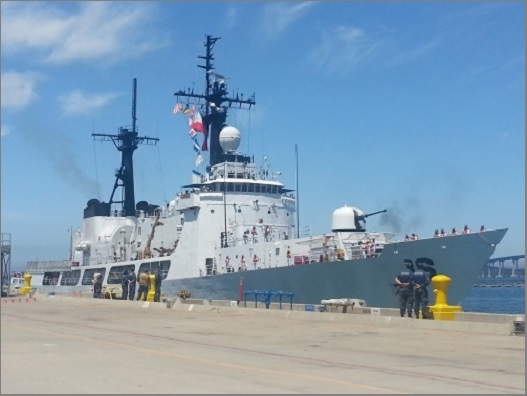
The frigate, BRP Ramon Alcaraz, sailed into the Philippines' Subic Bay, a former U.S. naval base.
BRP del Pilar was the country’s first Hamilton-class weather high endurance cutter (WHEC) acquired from the United States, in 2011. It will be used to patrol areas of the South China Sea near the Philippine coast that have become a major source of tension with Beijing.   The Philippines received the latest cutter for free under Washington's foreign military financing program, but spent about $15 million to upgrade its weapons and radar systems.   Hamilton-class ships have the basic modern technology the Philippine Navy needs to train its personnel, and has the size to install current and future weapons and sensors to keep it up-to-date for another decade.
Despite the removal by the US of its original radar systems, the PF-15 has new navigation and surface search radar and a new C&C/Common Operational Picture system. It also has a helicopter hangar and helideck for shipborne helicopter operations, and provisions for new radar and communications systems if the PN decides to install, provisions are also available to upgrade and up-arm the Hamilton-class ships.

The armed forces plan to buy radars, surveillance planes, fighters, and helicopters under the $1.7-billion plan.

Manila has opened talks to acquire a dozen new fighter jets and two frigates from South Korea. It has also ordered 10 coast guard ships from Japan and three more vessels from France.

He said the Hamilton-class ship will be deployed to Palawan and then to the Spratly Islands.

“It is to protect our interest in the natural resources operations that we have, more (specifically) in Malampaya…It is near Spratlys but basically, the objective is to protect our Malampaya (natural gas project)," he said.   the Navy would need to acquire “as many large-hull warships it can possibly get with its limited budget,” to show its presence and patrol the vast areas within the exclusive economic zone (EEZ).

22.4.14

North Dakota submarine construction delay...drone sub delivery?

an underwater launch of a a small Switchblade unmanned aerial vehicle. 
Problems with a new kind of missile launcher will delay the commissioning of the attack submarine North Dakota. The primary issue was the new “Virginia Payload Tubes,” or VPTs. These are a new way to carry Tomahawk cruise missiles. Block III submarines, of which North Dakota is the first and farthest along, will have two much bigger tubes, each capable of carrying six Tomahawks — or a smaller number of some larger future missile, or even potentially an unmanned mini-submarine. The VPM concept also has the flexibility to accommodate an unprecedented variety of payloads;such as swimmer delivery vehicles for special operations. Earlier “Block I” and “Block II” Virginia submarines have 12 conventional Vertical Launch System (VLS) tubes in the bow, each VLS holding one Tomahawk. But the Block III submarines, of which North Dakota is the first and farthest along, will have two much bigger tubes, each capable of carrying six Tomahawks — or a smaller number of some larger future missile, or even potentially an unmanned mini-submarine. 


 Military scientists have concluded submarine sailors, who traditionally begin a new workday every 18 hours, show less fatigue on a 24-hour schedule, and the Navy has endorsed the findings for any skippers who want to make the switch. The first submarine to try the new schedule on a full deployment was the USS Scranton, led by Cmdr. Seth Burton, a cancer survivor. He said the illness he experienced as a junior officer helped convince him of the health benefits of keeping a sleep pattern in line with the body's natural rhythm. "I know that there's lots of medical side effects to just not having a good, regular sleep pattern," said USS Scranton Cmdr. Seth Burton, 41, of Huntsville, Ala. A submarine sailor's day is generally divided equally into three periods: Time on watch, off time that is devoted partly to training and drills, and sleep. Under the new schedule, those time blocks are stretched from six to eight hours.


[March 9]

JROC moved the Virginia-class submarines in February 2013 from the Prompt Strike budget to the main Navy shipbuilding account. Will these silent propulsion pumpjet boats get a boost from the Ukrainian chill?
K-329


China’s navy is developing a land-attack cruise missile capability, most likely with the Type-095 SSGN  according to a forthcoming report by a US congressional commission on China.   The Russian navy has invested an estimated 54 billion roubles (£1bn) to fund the SSGN Severodvinsk K-329, and sources say delivery is expected imminently, since the delivery acceptance certificate was signed on 30 December. The K-329 was commissioned in 1993 and originally scheduled for delivery in 1998. The project has been beset by problems and repeated delays.
USS Ohio in 2008 [SSGN-726]


On July 16, a submarine left Bremerton, accompanied by a couple of Coast Guard cutters. The Navy declined to identify it, saying it doesn't discuss specific submarine operations.

Puget Sound Naval Shipyard's Intermediate Maintenance Facility completed its most expansive major maintenance period July 11 with USS Ohio's certification for unrestricted operation


A maritime source working in the Suez Canal reported on June 27 the passage of a nuclear submarine alongside two 'destroyers', both belonging to the United States supposedly headed to the Persian Gulf.

The maritime source added that the nuclear submarine – USS Florida SSGN 728 – and the destroyers –  USS JAMES E. WILLIAMS (DDG 95). and [? USNS Supply (T-AOE 6)] – were accompanied by tugboats belonging to the Canal during their 14-hour trip.

The destroyers and submarines were reported to be headed to the Persian Gulf in order to complete missions in the region.


YOKOSUKA, Japan (June 13, 2012) The Ohio-class guided-missile submarine USS Michigan (SSGN 727) is moored at Fleet Activities Yokosuka as part of its deployment to the Western Pacific.


The sending more equipment to the Gulf region is in the context of the efforts of U.S. Central Command to strengthen the U.S. military presence in the region for Iranian threats to close the Strait "of Hormuz.
During Operation Odyssey Dawn, Florida (SSGN 728) launched 93 Tomahawk missiles, with 90 effective, out of her total magazine of about 160 missiles.


16.4.14

Summer Wind: "I'm going to get you" said the captain, maybe.


Kirby claims the collision of Liberian-flag bulker Summer Wind with Kirby barges 27706 and 27705 and tugboat M/V Miss Susan has cost it more than $10 million in losses, damages, and expenses, and it is seeking a warrant of seizure and the sale of M/V Summer Wind to pay for damages, interest, attorney's fees, and court fees.   Kirby filed the suit in the Houston Division of the Southern District of Texas and is being represented by the Houston law firm Stepp & Sullivan PC.
Local news outlet KPRC Texas reported that the captains of both the Summer Wind and the Miss Susan were in communication about five minutes before the collision, and quoted the Summer Wind captain saying "If you keep on coming, I'm going to get you." Kirby Inland Marine LP (Kirby) has filed a lawsuit over last month's Houston Ship Channel collision seeking more than $10 million against bulk carrier M/V Summer Wind, its owner, Sea Galaxy S.A., and its operator, Cleopatra Shipping Agency Ltd.,


[March 25]
Penoyer said the investigation into what caused the collision has not determined who was at fault. “(The) investigation will take an extended amount of time to determine all of the factors that went into the cause ... It’s vastly premature to discuss any assessment beyond that.”

A search of the Coast Guard's accident investigation reports over the past ten years shows The Kirby Inland Marine-owned tugboat has been involved in eighteen incidents or accidents. Six of those were collisions with other vessels, docks and bridges.    The tugboat Miss Susan has also run aground and experienced mechanical failures, including loss of power or steering eleven times. 

[March 24]
 Apparently , a  Bulk Carrier departing from the port of Houston collided.
The ship was a 585-foot bulk carrier named the Summer Wind, IMO: 9114139. After the collision with a barge carrying bunker oil., the ship turned around and berthed at an anchorage at the Bolivar Peninsula. It remained there March 22.   manager CLEOPATRA SHIPPING AGENCY LTD, Greece.   Flag: Liberia

15.4.14

Big boxships too expensive to lay up


15 publicly traded container carriers in 2013 were at “a higher risk of financial distress than since the start of the financial crisis.” Carriers’ profits are now almost solely the result of cost-cutting. (Such as they are. The world’s top 15 container lines lost an estimated $1.1 billion between 2007 and 2012.)The average size of the modern-day containership is growing, with the largest vessels able to carry the equivalent of 9,000 forty-foot containers on a single voyage.Such behemoths are proving too expensive to lay up, resulting in fewer service withdrawals in 2013.

[March 13 2010]
Liberia flagged.E.R. LĂĽbeck, IMO 9222467, ex CSCL_Fuzhou.ex ER Fuzhou. ex ER evaded pirate attack in the Somali Basin some 450 nautical miles NE of the Seychelles in the late hours of 11th, stretching into the early hours of 12 March.

The LĂĽbeck was en route to Salalah when it was attacked from the rear of the ship, with pirates opening fire with automatic weapons. The ship sustained some minor small arms fire damage to the funnel and crane forward of the ship’s bridge. All personnel are reported to be safe and well.

Erck Rickmers, chairman and chief executive officer of Nordcapital and of E.R Schiffahrt GmbH & Cie KG (both located in Hamburg) has continued a family tradition that stretches back five generations.

Nordcapital started its activities in 1992 and has since become one of the leading German KG ship financing institutions. In 2001 it became market leader, with approximately Euro205m equity raised. Erck Rickmers explains We do not use Nordcapital for raising finance for E.R. Schiffahrt alone; we have also realised projects with eight different German shipowners (involving some 48 ships), including Bernhardt Schulte and Klaus Oldendorff, though E.R. Schiffahrt has become the main partner of Nordcapital in building up our current fleet of 39 containerships.
Ships in this category can be deployed flexibly all over the world. Their own loading gear makes them largely independent of shore-based loading and unloading facilities.