23.3.14

India blocks Chinese Malaysia Airlines flight MH370 search


Captain Liu Zhonghu aboard Chinese navy ship Jinggangshan in the Indian Ocean on March 20.

List of assets deployed by countries involved in the multi-national search and recovery mission for the missing Malaysia Airlines flight MH370 in the Southern Indian Ocean
 Royal Malaysian Navy vessels KD Kasturi, KD Lekiu, KD Selangor, KD Pahang, KD Terengganu and KD Kelantan.
Royal Australian Navy HMAS Success - Durance class multi-product replenishment oiler
China: Two amphibious transport docks, one destroyer, one frigate, one supply ship and one rescue ship from the Chinese navy, as well as 4 ship-borne helicopters. Another five ships from the country's maritime authorities, a bulk carrier and an icebreaker are also part of the search efforts.
 From Indonesian Military (TNI) and the National Search and Rescue Agency (Basarnas)  Eight  
 UK-   HMS Echo - multi-role hydrographic survey ships from Royal Navy, heading to SAR site.

Norway- 1 Merchant ship – Norwegian automobile carrier St. Petersburg.

[March 21] Indian Navy has four warships (INS Satpura, Sahyadari, Saryu and Batti Malv) deployed in the Bay of Bengal and Andaman Sea in continuation of the search for the jetliner. Extensive air searches are also being conducted with three aircraft (P-8I, C-130J and Dornier-228) in the area," said an officer.

Five Chinese ships are on route to the site, the country’s National Maritime Search and Rescue Centre said on March 21. The Chinese ice breaker Xuelong, currently at harbour in Perth, is set to join the search effort as soon as possible, the Xinhua news agency said. 

13.3.14

USS Truxtun starts exercise alongside counterparts from the Bulgarian and Romanian navies

Drazki


The joint naval exercise of US, Bulgarian and Romanian navies in the Black Sea has started,March 12, 2014. The military exercise was postponed on March 11 due to bad weather. The USS Truxtun, part of the US Sixth Fleet, together with Bulgarian naval frigate Drazki and three Romanian ships will take part in the drill in the Black Sea, BGNES reports. In the 2013 movie Captain Phillips starring Tom Hanks. All the DDG interior views were actually filmed on the USS Truxtun (DDG-103)


Albert, 24, and Cobler, 35, are both assigned to the destroyer Truxtun, a Norfolk, Va.-based ship that serves as a set piece in the film
The U.S. Navy announced March 06 that a guided-missile destroyer, the USS Truxtun, has left Souda Bay in Greece and will steam toward the Black Sea -- and the crisis in Ukraine.
Pentagon officials insisted that the move was unrelated to the rising tensions in the Crimean peninsula, which was seized by Russian forces. Still, with the United States and Russia locked in a tense standoff over the future of Crimea, the U.S. moving military assets toward Ukraine is fueling new jumpiness in the already unsettled region.
In one example, the Hurriyet Daily News newspaper in Turkey reported March 5 that a U.S. military ship would be maneuvering through the Bosphorus Straits on its way to the Black Sea in the following two days. The newspaper did not name the ship, but linked the plan to the crisis in Crimea.
Navy officials said the Truxtun's deployment has been planned for months. The ship's crew will train alongside counterparts from the Bulgarian and Romanian militaries. The Truxton carries about 300 sailors and is typically armed with Tomahawk cruise missiles and a variety of other weapons.

[March 5]

Ukrainian navy corvette Ternopil, at harbor of Sevastopol, Ukraine. The blankets and mattresses are placed over the side of the ship to hinder any attempted assault.

Ukrainian Navy units in Crimea remained cut off as of March 5 morning as pro-Russian radicals turned off electricity and water supplies, and blocked entrances to military units, the press and information department of the Ukrainian Defense Ministry reported on March 5.


Slavutych, Ukrainian command ship, U510

[January 2013]

The largest in post-Soviet history exercises of the Russian Navy started in the Black and Mediterranean seas. They involve warships of the Black Sea, the Baltic and Northern Fleets as well as other types of armed forces - the Army and the Air Force, including long-range aviation.
The highest status of the exercises is confirmed by the fact that, for the first time, the overall management responsibility was given to the Chief of General Staff, Colonel-General Valery Gerasimov. The exercises that will last until January 29, 2013

[January 11]

"A tactical group of Black Sea Fleet warships headed by the cruiser Moskva will undertake exercises in the eastern sector of the Mediterranean Sea," the Ministry said. "The tanker Ivan Bubnov has fuelled the ships and emergency drills have been carried out. On January 10 the tanker filled its fuel and water tanks and food stores at the Cyprus port of Larnaka."
A Baltic Fleet group consisting of the patrol vessel Yaroslav Mudry and tanker Lena will dock at Valetta on Malta for storing and to allow the crew to rest, the Ministry said. The ships will then head for the eastern Mediterranean, where the two ships will practice stores transfer at sea in day and night and the Yaroslav Mudry will carry out anti-submarine warfare drills.

[December 25]
“The main aim of sending the ships to the Mediterranean is to accomplish the missions set by the navy command, conduct exercises and show the flag.”
On December 24, Russian Deputy Defense Minister Anatoly Antonov dismissed media reports there were commando units and military equipment for Syria on board some of the warships.
A naval task force from Russia’s Northern Fleet left the Severomorsk base last Wednesday and set course for the Horn of Africa on a new anti-piracy mission, the Defense Ministry said.
It includes the large antisubmarine ship Severomorsk, the salvage tug Altai, and the tanker Dubna, as well as a contingent of naval infantry subunits. The force will travel the length of the Mediterranean, pass through the Suez Canal and relieve the Pacific Fleet task force that has been there on an anti-piracy mission since November.
A Baltic Fleet task force set sail December 18 for the eastern Mediterranean where it will relieve a group of Black Sea warships. The force includes the frigate Yaroslav Mudry, the large landing ships Kaliningrad and Alexander Shabalin, the salvage tug SB-921 and the tanker Lena.
The new anti-piracy mission is expected to reach the region by mid-January.
Russia keeps a naval task force in the Gulf of Aden as part of the international effort to fight piracy off the Somali coast.
On December 17, large landing ships Azov and Nikolai Filchenkov from Russia’s Black Sea Fleet left Novorossiysk for the Syrian port of Tartus. The ships are carrying naval infantry units for protection during the voyage. They are expected to join the Black Sea Fleet task force comprising the missile cruiser Moskva and the frigate Smetlivy in the Aegean Sea on December 28 before heading to Tartus.
Foreign Ministry spokesman Alexander Lukashevich confirmed on December 24 that Russia has a contingency plan for evacuation of Russian citizens from Syria if necessary.

[December 18]
The squadron of five ships that sailed from the Baltic Sea base of Baltiysk includes a destroyer, a tugboat, a tanker and two large amphibious vessels that could evacuate hundreds of people.
Another group of three navy ships departed Tuesday from Severomorsk, the main base of Russia’s Northern Fleet on the Kola Peninsula. While their official mission is anti-piracy patrol in the Gulf of Aden, the ships will sail past the Syrian shores and may linger there if need be.


A second coming to East African waters is at hand for the Marshall Shaposhnikov (BPK 543), a large Udaloy Class submarine destroyer which remains one of the flagship vessels of the Russian Navy Pacific Fleet despite the 28 years it has spent on active service.   The Russian Navy's Pacific Fleet has dispatched a fresh squadron of three vessels to combat piracy off the East African coast.

The squadron comprises destroyer Marshall Shaposhnikov, the oil tanker Irkut and the rescue tug Alatau. The flotilla sailed out of the Pacific Fleet naval base in Vladivostok on November 2, heading for the Arabian Sea.

While en-route to the Gulf of Aden the vessels will hold an exercise with the Indian Navy and call at its port of Mumbai. The vessels will also visit Djibouti as they join an international naval anti-piracy force which comprises vessels from the European Union, the United States, China, India, Iran and South Korea.

After a three-month deployment, the squadron will return to Vladivostok in a voyage that will include stop-overs in naval bases in the Seychelles, Thailand and South Korea. The flotilla also becomes the Russian Navy's eighth naval patrol squadron to be deployed with the international forces in the Red Sea and Indian Ocean since anti-piracy and maritime operations began three years ago.


"Our military medics gave the necessary medical help to all of the wounded bandits. We loaded the dead bandit's body onto one of the pirates' boats with the rest of the pirates, and sent it to the nearest coast, towards Somalia." [approximately 290NM east of Socotra Island]

"We loaded water, food and all their other things -- except the confiscated weapons, boarding ladders and navigation tools -- into the pirates' boat," he said.

"The further fate of the released pirates is not known to us."

Brigade Captain Ildar Akhmerov, the commander of a group of warships in Russia's Pacific Fleet, made the comments aboard the Marshal Shaposhnikov, the destroyer that led the operation to free the captured tanker.


"We will have to act as our forefathers did when they met pirates", Russian President Dmitry Medvedev pledged. "Of course, we will fight pirates with the full force of the naval law."

8.3.14

Klos C at Eilat after Israeli arrest for arms smuggling

An Israeli Navy boat escorts the Panamanian-flagged cargo vessel Klos C into the Israeli port of Eilat on Saturday after seizing it in the Red Sea on Wednesday, March 8, 2014.

 Name: Klos C IMO: 8918710

Flag: Panama MMSI: 373773000

 Callsign: 3FWB8

Former name(s): - Klostertal (Until 2012 Jul) - Otztal (Until 1996 Jul)

Technical Data Vessel type: General Cargo Gross tonnage: 5,624 tons Summer DWT: 6,985 tons Length: 110 m Beam: 18 m Draught: 5.3 m Additional Information Class society: Germanischer Lloyd Build year: 1996 Builder (*): Severnaya Verf St.petersburg, Russia


Owner: Whitesea Shipping &Trading

Marshall Islands

Manager: Whitesea Shipping &Trading Marshall Islands


the Turkish protest ship Mavi Marmara 
 [January 23 2011]


A 300-page reported released Sunday by Israeli government-appointed commission said the the soldiers' use of lethal force "were found to be legal pursuant to the rules of international law."

The commission, headed by a retired Supreme Court justice, included four Israeli members and two international observers — David Trimble, a Nobel peace laureate from Northern Ireland, and Brig. Gen. Ken Watkin, Canada's former chief military prosecutor. All signed off on the conclusions. aeli naval commandos killed nine activists aboard the Turkish protest ship Mavi Marmara on May 31 after passengers resisted the takeover of the vessel in international waters.

28.2.14

SSV-175 Viktor Leonov (ex Odograf 1988 Northern Fleet) in Cuba

SSV-175 Viktor Leonov 


SSV-175 Viktor Leonov (ex Odograf 1988 Northern Fleet)
Type: Intelligence collection ship 
Displacement: 3,470 tons full load
 Length: 94.4 m Beam: 14.6 m Draught: 4.5 m Propulsion: 2 shafts, 
2 Sulzer diesels, 4,400 bhp Speed: 16 knots Complement: 146 (= 6 passengers) 
Sensors and processing systems: 
Sonar: Pamyat hull mounted arrays, HF dipping Electronic warfare & decoys: 
Intercept arrays 
Armament: 
 2 × AK-630 six-barreled Gatling 30 mm/L60 guns 
2 x SA-N-8 surface-to-air missiles


[2013]
USS Cowpens{CG 63)


Chinese Foreign Ministry spokeswoman Hua Chunying said Kerry and Japanese Prime Minister Shinzo Abe, who has been equally critical of the air Defense zone, should stop harping on the issue. "The show the relevant parties have put on is enough. They should give it a rest. If they really care about this region's peace, they should ... stop fomenting trouble," China's official news agency Xinhua, in an English language commentary, accused the U.S. ship of deliberately provocative behavior. "On December 5, U.S. missile cruiser Cowpens, despite warnings from China's aircraft carrier task group, broke into the Chinese navy's drilling waters in the South China Sea, and almost collided with a Chinese warship nearby," it said. "Even before the navy training, Chinese maritime authorities have posted a navigation notice on their website, and the U.S. warship, which should have had knowledge of what the Chinese were doing there, intentionally carried on with its surveillance of China's Liaoning aircraft carrier and triggered the confrontation."
[December 17]
A day after the United States gave $32.5 million to stiffen maritime security in South East Asia, the bulk of it for Vietnam, Kerry said the United States would provide $40 million to the Philippines over three years to build its capacity to police the South China Sea. "We don't view the situation as one of rising tensions and we don't want rising tensions," Kerry told a news conference with his Philippine counterpart Albert del Rosario. "What we are involved in are normal processes by which we work with other countries in order to raise their maritime protection capacity."

[December 16]

"Bad guys always claim innocence first," a Chinese source that was familiar with this confrontation, told the Global Times on Sunday, adding that the American missile cruiser had entered within 45 kilometers of the inner defense layer of the Chinese fleet that day. 

"The USS Cowpens was tailing after and harassing the Liaoning formation. It took offensive actions at first towards the Liaoning formation on the day of the confrontation," said the source.

It is a fact that China has already announced three regions in the South China Sea as its military areas. The outside world knows that they are used for scientific research and training of the Liaoning aircraft carrier. Meanwhile, many areas in the South China Sea are China's exclusive economic zones. Clearly, the US missile cruiser has come to China's threshold and posed a threat to China's military security, says An official Chinese newspaper

  U.S. Secretary of State John Kerry announced December 16 that the United States will boost maritime security assistance to the countries of Southeast Asia amid rising tensions with Beijing.

On his first visit to Vietnam as America's top diplomat, Kerry pledged an additional $32.5 million for members of the Association of Southeast Asian Nations to protect their territorial waters and navigational freedom in the South China Sea, China's new East China Sea air defense zone, saying it "clearly increases the risk of a dangerous miscalculation or an accident" that could lead to possible conflict between China and Japan over a string of small islands that each claim as their own.

The United States is "very concerned about recent actions that have increased tensions between China and Japan and we call for intensified negotiations and diplomatic initiatives.

"The zone should not be implemented, and China should refrain from taking similar unilateral actions elsewhere, particularly in the South China Sea,"


[December 14]
On December 5, 2013, USS Cowpens, (CG 63) was involved in a minor confrontation with a small Chinese warship that was escorting the Chinese aircraft carrier Liaoning while operating in International waters in the South China Sea. The Chinese amphibious dock ship [Jinggang Shan (999 /井冈山) Type 071 Yuzhao class amphibious transport dock (LPD)?] crossed directly in front of the Cowpens and then halted. The two vessels were barely 500 yards away when the captain of Cowpens ordered "all stop".

The US Navy said that the USS Cowpens, (CG 63) a guided-missile cruiser, had been forced to take evasive action to avoid a collision with a ship from the People’s Liberation Army Navy on December 5. Another U.S. military official said that the incident was ultimately resolved through ship-to-ship communications via radio between the Cowpens and a Chinese aircraft carrier in the vicinity. The official said that at some point there was direct communication between the Cowpens and the Chinese vessel that was harassing it, but the official was unaware of what was said during the exchange.

[{December 6]


But China’s declaration of the expanded air control zone highlighted a potentially volatile dispute between China and South Korea, since it covered Ieodo, a submerged reef south of Jeju, an island off the south coast of South Korea. Ieodo, which South Korea says it effectively controls, is believed to be surrounded by natural gas and minerals deposits.


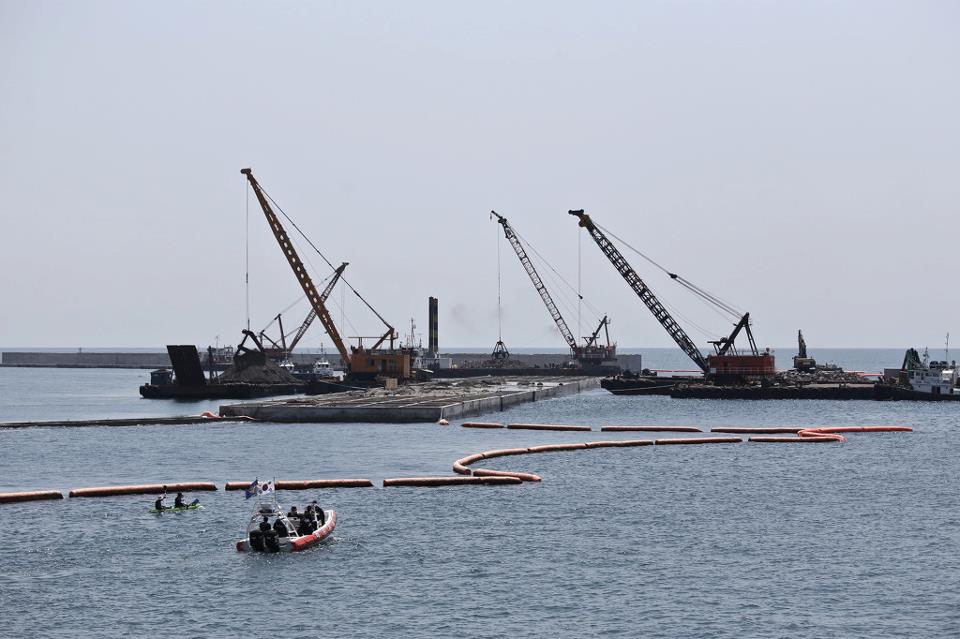
Despite fierce protests from environmentalists, South Korea is building a $970 million naval base in Jeju, a home for 20 warships, including submarines, that the navy says will protect shipping lanes in the East China Sea for South Korea’s oil-dependent, export-driven economy as well as enabling it to respond quickly to any dispute with China over the rock.


Under international maritime law, countries cannot claim a submerged rock as territory but can claim the right to control and use waters and natural resources around it. Both China and South Korea claim such rights over the reef. Currently, the Korea Hydrographic and Oceanographic Administration manages a research station built on the rock. The partial demolition of the 1.2 kilometer-long rock formation is scheduled to take place over the following three months.


The Jeju Naval Base (Hangul: 제주 해군기지; Hanja:濟州海軍基地) is a planned military base on Jeju Island, South Korea (coterminous with Jeju Province, or Jeju-do).


;April 12 2013]

Korean media said Han Jun deploy two Aegis-class warships to monitor North Korean missile.   Yonhap quoted South Korean military sources as saying, in response to the possibility of North Korea launched a medium-range missiles, South Korean military has deployed in waters near two equipped with radar Aegis destroyers used to monitor and t rack.

The source said the two 7,600-ton Aegis destroyers were deployed in Korean waters east and west sides standby, two warships are equipped with a detection range of 1,000 kilometers of the SPY-1 radar if North Korea launched a missile can be rail track.

27.2.14

Maersk Alabama: last calls of guards found dead

Workers at Victoria International Casino described the men as jovial. They were eventually escorted out at 3 a.m. when the casino closed. “I told them, ‘Hey look, we need to close,’ ” Mr. Nanty said. “ ‘You have to leave.’ ” At 6 a.m., the police report noted, they returned to the ship. It was in Mr. Kennedy’s cabin, more than 12 hours later, that a ship security officer discovered the two men on Feb. 18. Mr. Reynolds was slumped on the bed, and Mr. Kennedy was lying face up on the floor, a syringe in his left hand, brown heroin powder in the room, according to police reports. Drug use was prohibited. [February 25] Two ex-Navy Seals found dead last week aboard the ship made famous in the film Captain Phillips died of respiratory failure after suspected heart attacks, Seychelles police have said Two American security officers have been found dead on the Maersk Alabama container ship, police in the Seychelles said February 19. Seychelles police identified them on February 20  as Jeffrey Reynolds and Mark Kennedy. The men, both 44, were found dead on February 18 "A postmortem will be carried out this week in order to establish the cause of their sudden deaths," police said, adding that the police investigation is ongoing. The 500-foot Maersk Alabama was targeted by Somali pirates in an attempted hijacking off the east coast of Africa in 2009. The 2013 film "Captain Phillips" is based on the incident. Reynolds and Kennedy worked for Trident Group, a Virginia-based maritime security services firm. The company's president, Tom Rothrauff, said the men were former Navy SEALs. "It's bizarre. Of course, it's a shock. They're all great guys," Rothrauff said. "I'm absolutely clueless as to what happened." 

Frank Peake, The former president of Sea Star Line LLC, was sentenced to serve five years in prison and to pay a $25,000 criminal fine for his participation in a conspiracy to fix rates and surcharges for freight transported by water between the continental United States and Puerto Rico. As a result of the ongoing investigation, the three largest water freight carriers serving routes between the continental United States and Puerto Rico, including Peake’s former employer Sea Star, have pleaded guilty and been ordered to pay more than $46 million in criminal fines for their roles in the conspiracy.

Sea Star pleaded guilty on Dec. 20, 2011, and was sentenced by Judge Dominguez to pay a $14.2 million criminal fine. Sea Star transports a variety of cargo shipments, such as heavy equipment, perishable food items, medicines and consumer goods, on scheduled ocean voyages between the continental United States and Puerto Rico.

Peake and five other individuals have been ordered to serve prison sentences ranging from seven months to five years. Additionally, Thomas Farmer, the former vice president of price and yield management of Crowley Liner Services, was indicted in March 2013 for his role in the conspiracy and is scheduled to go to trial in May 2014.In 2009, two former Sea Star executives and three former Horizon Lines employees were sentenced as a result of the price-fixing investigation. Peter Baci, who had been senior vice president at Sea Star Line, received the stiffest punishment with a four-year prison sentence and $20,000 fine.

[September 5]


The true story of Captain Richard Phillips and the 2009 hijacking by Somali pirates of the US-flagged MV Maersk Alabama, the first American cargo ship to be hijacked in two hundred years.

Trailer


[10/29/09]


Billy Ray has been tapped to pen Columbia Pictures' Somali pirate pic.

Based on true events that unfolded earlier this year, the untitled film centers on captain Richard Phillips, who was held hostage by four Somali pirates and was subsequently rescued by a group of Navy SEALs.

Col picked up the cargo ship captain's life rights in May, weeks after his dramatic capture by armed Somali pirates, his attempted escape and eventual rescue. At the time, the studio also optioned the film rights to Phillips' upcoming memoir, "A Captain's Duty: Somali Pirates, Navy SEALs and Five Dangerous Days," which will be published in April by Hyperion.

Michael De Luca, Kevin Spacey, Dana Brunetti and Scott Rudin are producing.

Ray's recent writing credits include "State of Play," "Flightplan" and "Breach," the last of which he also directed. He is currently writing "Gears of War" for New Line and "Motorcade" for DreamWorks.

24.2.14

USS Donald Cook: sm-3 interceptor missile-equipped destroyer arrives at Rota Spain

PACIFIC OCEAN (Feb. 13, 2013) A Standard Missile-3 (SM-3) Block 1A interceptor is launched from the guided-missile cruiser USS Lake Erie (CG 70) during a Missile Defense Agency and U.S. Navy test in the Pacific Ocean. The SM-3 Block 1A successfully intercepted a target missile that had been launched from the Pacific Missile Range Facility, Barking Sands, Kauai, Hawaii.


The USS Donald Cook, which arrived at Rota Naval Station, Spain on 11 February, is the first of four ballistic missile defence (BMD)-capable destroyers that will be stationed at the base. The ships are capable of tracking and shooting down ballistic missiles in flight, using their Aegis radar system and SM-3 interceptor missiles. These capabilities will make the destroyers a key component of NATO’s missile defense shield for Europe.

[March 19 2011]


112 Tomahawk cruise missile were fired from five U.S. ships — the guided-missile destroyers USS Stout and USS Barry, and three submarines, USS Providence, USS Scranton and USS Florida.
USS Florida (SSGN-728), an Ohio-class ballistic missile submarine, was the sixth ship of the United States Navy to be named for the 27th state. She was converted to a cruise missile submarine, and re-designated SSGN-728.
back
and back
and and

12.2.14

MT Kerala: tale of George Procopiou's recovered product carrier


Pirates disabled the vessel’s AIS and other communication equipment so that the vessel could not be tracked from shore or satellite, painted over the identifying features of the vessel, including funnel, name and IMO number and undertook three separate ship-to-ship transfers of cargo amounting to the theft of approximately 12,271.5mt of cargo.

The owners of the Liberian-flag KERALA regained contact with the vessel on January 26, 2014, shortly after the pirates had disembarked. The vessel then immediately set a course for the safety of the port of Tema, Ghana, as a port of refuge.

A gang of Nigerian pirates reportedly stole a tugboat and sailed south into Angolan waters on January 18, 2014 where they attacked the oil products tanker carrying 60,000 metric tons of diesel, a few miles off the coast of Luanda, the capital of Angola.The Gulf of Guinea, a major commodities route, which covers an immense area extending from the Guinean coast to offshore Angola, has now become a piracy hotspot, where pirates attack oil tankers and other cargo vessels. They seize large oil tankers and load oil onto other ships to sell on the lucrative black market.

[March 3 2013]

Panama-flagged MV Royal Grace, a chemical tanker which was captured on March 2, 2012, and the Greek-owned oil tanker Smyrni, seized on May 11, 2012, are heading to Salalah, Oman.  
Mumbai: Due to coordinated actions of Ministry of Shipping, External Affairs, Defence, Home Affairs, Director General Shipping and other important agencies, on March 8 we could get release of two vessels MV Royal Grace hijacked in March 2012 and MT Smrini hijacked in May 2012. Twenty eight Indian sailors held hostage by Somali pirates have been released. The sailors were on board two ships Merchant Tanker Royal Grace and Merchant Tanker Smyrni and 17 were on board the MT Royal Grace and 11 were on board the MT Smyrni.
The Indian sailors have been released but they are yet to reach a safe zone. Both the ships were hijacked off the coast of Somalia in 2012.
Shipping Minister GK Vasan made the announcement in Chennai, saying the government secured the release of the sailors on board the two vessels due to coordinated efforts of the Ministries of Shipping, External Affairs, Defence, Home Affairs, Director General Shipping and other agencies. "I am very happy to announce the release of Indian seafarers. Due to coordinated actions of Ministry of Shipping, External Affairs, Defence, Home Affairs, Director General Shipping and other important agencies, on Friday we could get release of two vessels MV Royal Grace hijacked in March 2012 and MT Smrini hijacked in May 2012," Vasan told reporters in Chennai.
                After failing to receive help from the Government of India, the families of 17 Indian crew members of the MV Royal Grace sought help of a Pakistani-based activist Ansar Burney.   Burney, who runs the Ansar Burney Trust, was earlier successful in freeing the crew of MV Suez in June 2011, during another hijacking by Somali pirates
[June 5, 2012]


The tanker is near Bargaal. Pirates on board the Smyrni claim they are planning to move south to Garacad area and then onto Harardhere and Hobyo in Galmadug. Or they will move north to the northern tip of Puntland in Qandala or Caluula or south into Galmadug outside the operational area of Puntland. 
The market value of the crude oil loaded in Turkey and destined for refining in eastern Borneo is around $115 million.


George Procopiou 


The Liberian-flagged Tanker, the M/T SMYRNI,Imo 9493779 is carrying a cargo of 135000 MT of crude oil managed by Dynacom Tankers Management Ltd. (with a further 40 vessels in the fleet)  was attacked by 2 pirate skiffs approximately 285nm SSE of Masirah Island, Oman. and  hijacked while it was transiting the Arabian Sea.   No communications have been received from the ship since the ship was boarded.

The attack occurred at 0930 UTC, May 10.


Ship Type: Oil products tanker
Year Built: 2011
Length x Breadth: 275 m X 48 m
Gross Tonnage: 83562, DeadWeight: 149998 t
Speed recorded (Max / Average): 9 / 9 knots
Flag: Liberia [LR] 
Call Sign: A8YB6
IMO: 9493779, MMSI: 636015015 


Owner:Pisces Finance Ltd.
Class Society:American Bureau of ShippingOperator:Pisces Finance Ltd. / Dynacom Tankers Management Ltd.


Pisces Finance II Limited was incorporated in 2002 and is based in Cricket Square, Cayman Islands.
Mr. George Procopiou Founded Dynacom Tankers Management Ltd. and serves as its Chairman of the Board. Mr. Procopiou serves as Director of The North of England Protecting and Indemnity Association Limited.Dynacom Tankers Management, Ltd., a shipping company, operates cargo vessels for the oil industry. It operates a fleet of double hulls, very large crude carriers (VLCC), tankers, and LNG carriers. The company was founded in 1991 and is based in Athens, Greece with additional offices in Bombay and New Delhi, India; Singapore, Singapore; Fujaira, the United Arab Emirates; and a representation in Beijing, China.

94 Vas Georgiou B/2 Nikis Street
Glyfada
Athens,  166 75
Greece
Founded in 1991
George J. Procopiou’s business card states that his title is Civil Engineer. That fits very well with the personal style of Dynacom, a family-operated company in Glyfada, just outside Athens in Greece.

But the impression of a family-owned and -operated shipowner confirms the commitment to shipping and to running a professional company. It is hands-on for Mr Procopiou, whose company will take delivery of no fewer than 21 newbuildings next year. “Running Dynacom is both our business and hobby,” says Procopiou, underlining that it is teamwork that creates success and not a one-man show. Transforming Dynacom from a company operating basically second-hand tonnage into the present-day operator of a young fleet with an ambitious newbuilding programme is quite an achievement, and we are pleased to have an opportunity to learn more about the company from the very engaged George Procopiou, Civil Engineer, who occupies the corner office.“Since 2000, we’ve ordered no fewer than 85 newbuildings, and next year (2009) we will take delivery of another 21 vessels. We have good in-house expertise on newbuildings and on what we should look for when it comes to additions and changes to the yard designs. Normally, when we go through the specifications we end up with some USD 4–6 million in additions. This means that we take delivery of vessels made to our specifications, and the important thing here is that these vessels are as attractive to us as they are to potential users” says Procopiou.

One of the main reasons for Dynacom’s success is the company’s in-depth knowledge of shipping acquired over a long-term period. The company has first-rate operational and technical knowledge of the vessels. “The enthusiasm for what we do in terms of shipping experience and know-how makes our people stay on – we are all very proud of our achievements as we all identify ourselves very strongly with our company. 
The fleet today comprises some 50 vessels – mostly tankers and some LNG carriers,” he says.

Environment
Fuel prices are on the way up, as has been the case for a while. Engine manufacturers must maintain a focus on achieving the best possible fuel consumption and least possible emissions. Slowing down 
vessels to reduce the per mile fuel consumption and consequently emissions is 
of course a quick fix for air pollution issue. It is the engine makers task to design and build engines with lower 
emission levels. 
A longer term solution might be in switching from fuel oil to LNG. 
On the suggestion that larger vessels could be more environment friendly, this is a complex issue as many factors have 
to be in line to enable the use of larger 
vessels, such as port sizes water depth, shore installations. All such topics should be addresses simultaneously and under the spectrum of the global effects on 
pollution and not the regional ones.


LNG 
The move into the highly specialised LNG business, which used to be a rather closed business segment with particularly high standards, confirms Dynagas’s commitment to shipping and energy transportation and it achieved due to the company’s high standards and knowledge. “The age of our LNG vessels is less then two years The LNG market is soft for the time being, but I strongly believe that this will change over time. Two main reasons for this are that using coal for power production is not all that environmentally acceptable in many countries and, with the soaring prices for oil products, power production based on oil will have to be reduced. In many countries, nuclear power is either banned or has a bad public image. That leaves natural gas, as it is much more environmentally friendly with lower levels of CO2 emissions and almost no SOx and NOx emissions. Some projects have been delayed as the LNG production facilities either have not been finished in time or are experiencing technical problems. But the orders for ships are there and right now there are too many vessels waiting