27.9.13

Deepwater Horizon: ecosystem could take decades to recover


The Deepwater Horizon disaster could have a lasting impact on the Gulf of Mexico, according to a new paper suggesting that the region’s deep-sea soft-sediment ecosystem could take decades to recover from the 2010 oil spill.

The authors claim  provides comprehensive results on the spill’s effect on deep-water communities at the base of the Gulf’s food chain for the first time.

The spill resulted from an explosion on board the Deepwater Horizon oil rig that occurred on April 20, 2010, and resulted in a total of 4.9 million barrels (205.8 million gallons) of crude in what went on to become the largest offshore oil spill in US history.

BP’s internal records for the Macondo project conflicted with numbers sent to drilling regulators and established a pattern of “consistent misreporting” of well pressures, Alan Huffman, a Houston-based petroleum geophysicist, testified for the U.S. government in a trial over claims tied to the 2010 Gulf spill. The fudged numbers allowed BP to continue drilling for oil, he said.
The oil company created “a very misleading impression” about the well’s safety conditions and engaged in drilling operations that “I’ve never seen an operator do,” Huffman told a judge February 27 in New Orleans.
After hearing evidence in the trial, U.S. District Judge Carl Barbier in New Orleans will decide who is liable for damages tied to the largest offshore spill in U.S. history and whether BP, Transocean Ltd. (RIG) or other companies that worked on the project were grossly negligent in their handling of the rig and well. His ruling in the nonjury trial on that issue will affect how much each company may have to pay.

[January 14]

Agreement Reached with U.S. Department of Justice on Deepwater Horizon Claims
ZUG, SWITZERLAND-Transocean Ltd. (NYSE: RIG) (SIX: RIGN) today announced that it has reached an agreement with the U.S. Department of Justice to resolve certain outstanding civil and potential criminal claims against the company arising from the April 20, 2010, accident involving the Deepwater Horizon in the Gulf of Mexico.

As part of this resolution, a Transocean subsidiary has agreed to plead guilty to one misdemeanor violation of the Clean Water Act (CWA) for negligent discharge of oil into the Gulf of Mexico and pay $1.4 billion in fines, recoveries and penalties, excluding interest.  This resolution will result in the Department of Justice concluding its criminal investigation of Transocean and settling its claims for civil penalties against the company relating to the spill from BP's Macondo well.  The company intends to satisfy its payment obligations over a period of five years, using cash on hand and cash flow from operations.  At September 30, 2012, Transocean had accrued an estimated loss contingency of $1.5 billion associated with claims made by the Department of Justice.

more
[June 15 2010]
IMO number: 8764597
The DEEPWATER HORIZON was a Reading & Bates Falcon RBS8D design semi-submersible drilling unit capable of operating in harsh environments and water depths up to 8,000 ft (upgradeable to 10,000 ft) using 18¾in 15,000 psi BOP and 21in OD marine riser. here

Marshall Islands Registry in the hot seat: "The Deepwater Horizon oil rig that exploded in the Gulf of Mexico was built in South Korea. It was operated by a Swiss company under contract to a British oil firm. Primary responsibility for safety and other inspections rested not with the U.S. government but with the Republic of the Marshall Islands — a tiny, impoverished nation in the Pacific Ocean." full story
Guardian

BP’s single largest shareholder is the sprawling asset management firm BlackRock, based in New York City, which owned the equivalent of more than one billion shares of BP stock just two weeks before the Deepwater Horizon blowout, according to the financial analysis firm Capital IQ. (Bank of America owns a 34.1 percent stake in BlackRock.)

The second-largest American owner, and third largest over all, is State Street Global Advisors, based in Boston, with 307 million shares. After them are the mutual fund firm Capital Research and Management Company of Los Angeles, with 247 million shares, and the Vanguard Group, based in Malvern, Pa., with 140 million shares. Rounding out the top five is Franklin Resources of San Mateo, Calif., another publicly owned asset management firm, with 131 million shares.

More familiar names crop up further down the list, like Fidelity Investments, with 124 million shares; T. Rowe Price Group, with 93 million shares; and State Farm Insurance, with 79 million shares.

Then there are the banks: as of March 31, JPMorgan Chase held a respectable 76 million shares; Bank of America, 69 million shares; and Goldman Sachs, 42 million shares.

The Bill & Melinda Gates Foundation is another a major investor, with nearly 43 million shares.

here

26.9.13

Perro Negro 6: salvage tender out for sunken rig


A salvage operation to remove the wreck of drilling rig Perro Negro 6, operated by Italian oil services group Saipem, will get underway once Saipem picks a contractor following a recent tender.

The timing (of the removal) is depending on the offer that will be presented by the winner of the tender.

On July 1, the rig capsized as it was laying a pipeline linking Chevron's Block 0 and 14 with the liquefaction plant.

The disaster claimed one fatality and has for the time being cut off supplies from the Chevron-operated blocks, which were to be tied to the plant next year, supplying up to 170 million cubic feet of gas per day initially.


[July 4]
San Donato Milanese (Milan), July 2, 2013– Saipem informs that last night, July 1, the jack up drilling rig Perro Negro 6, due to the collapsing of the seabed under one of the three legs, suddenly tilted and suffered hull damages, causing water intake. The event occurred during the rig positioning on location prior to starting drilling operations, between the coasts of Angola and the Democratic Republic of Congo, near the mouth of the Congo River, in approximately 40 metres of water.
At 10.30 AM CEST, the rig, with no personnel on-board, capsized and sank.
The emergency procedures were promptly activated last night to ensure the evacuation of the personnel on-board. After the sudden and significant tilting, among the 103 crew members, one was recorded missing and another six incurred minor injuries.

20.8.13

KKR, CPPIB, Stone Point into Maritime


KKR has created a finance company to supply credit to maritime borrowers, including offshore oilfield services and traditional shipping companies, as the buyout group seeks to build a presence in maritime finance.   Maritime Finance will initially be capitalized with $580 million of equity, over 45% of which has been provided by KKR, including through its balance sheet, KKR Financial Holdings LLC (NYSE: KFN) and MerchCap Solutions ("MCS"), KKR's recently established mid-market focused merchant banking venture with CPPIB and Stone Point Capital. The balance of the capital was arranged by MCS and included participation from various family offices, mutual funds, hedge funds and specialist financial services investors. Proceeds will be used by the Company to fund its establishment and operation, provide capital for newly originated maritime financings and potentially acquire a seed portfolio of outstanding loans.


14.8.13

INS Sindhurakshak: snorkel sub has caught fire and sunk


INS Sindhurakshak has caught fire and sunk with about 18 crew on board after an explosion at a port in Mumbai.    Latest emerging visuals are indicating that multiple blasts could have taken place outside 

- India relies on its submarines to conduct a second strike on the enemy in a nuclear war scenario, the navy said in a maritime military strategy report released in 2007.   This sub is equipped with Russian Club-S cruise missile systems.

The 16-year-old Russian-made submarine,had recently returned from Russia after undergoing an overhaul and upgrade.

India has 14 diesel-powered submarines.   Sindhurakshak was constructed in Admiralty Shipyard, St. Petersburg. Construction of the submarine began in 1995. It was launched in June 1997 and delivered in December 1997.


Class & type: Sindhughosh-class submarine
Displacement: 2325 tons surfaced
3076 tons dived
Length: 72.6 m (238 ft)
Beam: 9.9 m (32 ft)
Draught: 6.6 m (22 ft)
Propulsion: 2 x 3650 hp diesel-electric motors
1 x 5900 hp motor
2 x 204 hp auxiliary motors
1 x 130 hp economic speed motor
Speed: Surfaced: 10 knots (19 km/h)
Snorkel Mode: 9 knots (17 km/h)
Submerged: 17 knots (31 km/h)
Range: Snorting: 6,000 mi (9,700 km) at 7 kn (13 km/h)
Submerged: 400 miles (640 km) at 3 knots (5.6 km/h)
Endurance: Up to 45 days with a crew of 52
Test depth: Operational Depth: 240 m (790 ft)
Maximum Depth: 300 m (980 ft)
Complement: 68 (incl. 07 Officers)[1]
Armament: 9M36 Strela-3 (SA-N-8) surface-to-air missile
3M-54 Klub-S anti-ship and land-attack missiles
Type 53-65 passive wake homing torpedo
TEST 71/76 anti-submarine active-passive homing torpedo
24 DM-1 mines in lieu of torpedo tube

25.7.13

Scarabeo 8: first exploration well off Hammerfest in 32 years

The drilling rig Scarabeo 8


Det Norske Veritas has won a bid to provide environmental and emergency preparedness risk analysis for Statoil’s Johan Castberg project in the Barents Sea . Statoil got the go-ahead from Oslo to drill the first exploration well in one of its Barents Sea licenses . Meanwhile the company is reportedly kicking off seismic studies in the Sea of Okhotsk in cooperation with Rosneft (Upstream).

The drilling rig Scarabeo 8 appeared overnight Monday this week off Ersvika near Hammerfest, the first time a rig has visited Hammerfest in 32 years. The rig is taking advantage of the area’s sheltered waters to perform some tricky refitting 
The Castberg project, which may hold as much as 600 million barrels of recoverable crude, has helped rekindle interest in the Barents Sea after a decade of disappointing results.
Statoil, based in Stavanger, is the operator of the field and has a 50 percent stake. Italy’s Eni SpA has 30 percent, and Petoro AS, which manages Norway’s direct stakes in its oil and gas fields, holds 20 percent. Statoil had originally planned to submit a plan for development and operation to the government for approval next year before starting production in 2018.
Norway remains committed to developing the waters off its northern coast and expects “a lot of licensing” in the Barents Sea when the results of the 22nd licensing round are announced “in the near future” . The government will consider regional support for oil and gas activities if needed, as was done with the development of the Snohvit gas field off the coast of Hammerfest.

23.7.13

Deepwater Millennium: gas discovery offshore Mozambique

Transocean’s Deepwater Millennium is performing an accelerated well testing program that includes installing observation gauges and conducting several drill stem tests for Anadarko’s natural gas wells offshore Mozambique. 
 Anadarko Petroleum Corporation reported July 18 that it has discovered a new natural gas accumulation within Offshore Area 1 of the Rovuma Basin, offshore Mozambique.
 The Orca-1 discovery well encountered approximately 190 net feet of natural gas pay in a Paleocene fan system.

Videocon Industries has sold off to ONGC Videsh and Oil India (OIL) for $2.48 billion (Rs 14,880 crore) its 10 per cent interest in the prolific oil and gas offshore block in Mozambique’s Rovuma basin. The deal is expected to help Videocon reduce its huge debt and provide a piece of pie to the two Indian oil and gas explorers chasing resources abroad.

ONGC Videsh, the wholly owned subsidiary of Oil and Natural Gas Corporation (ONGC), and OIL expect to implement the acquisition through a newly incorporated entity in which OVL would hold 60 per cent stake while OIL would have 40 per cent stake by the end of this financial year.

 The largest deal of the quarter involved ONGC and Oil India, who acquired a 10% stake in the 100+ tcf gas discovery offshore Mozambique in the Rovuma basin for $2.5 billion from Videocon Industries. The $0.50 cost per recoverable mcf of gas reserves would usually represent good value but commercialization of the asset is at least five years away and will require large upfront payments to develop the field and construct the necessary LNG exporting terminal which would have made this field fall short of many public companies’ investment appraisals. The deal follows the acquisition of Cove Energy at the end of 2012 when another national oil company, PTT, keen to gain control of the company’s flagship asset of an 8.5% interest in the Rovuma Offshore Area 1, paid $2.2 billion.


2.7.13

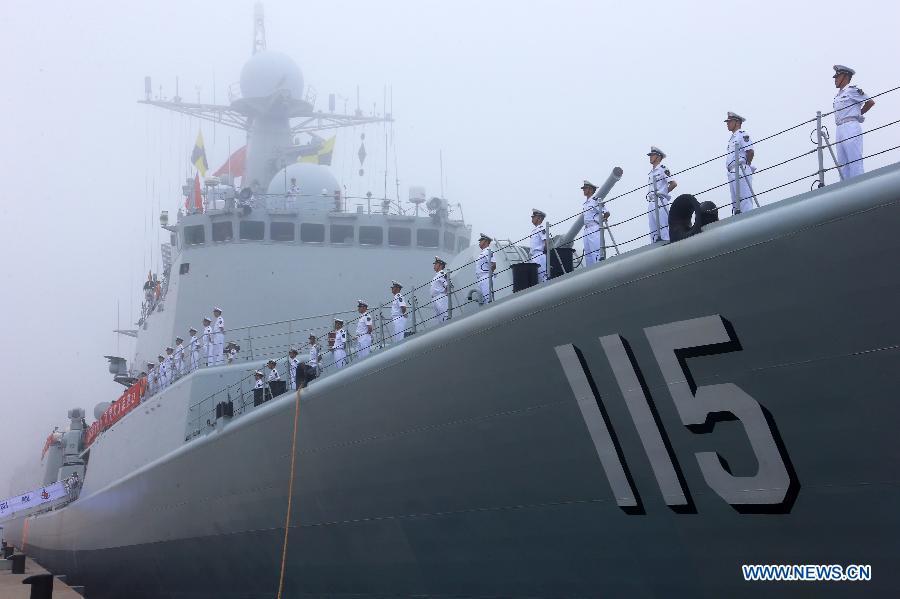
115 沈阳 / Shenyang, 116 石家庄/ Shijiazhuang in Russia-China naval drill


China's defence ministry said on July 2 that its navy would send four destroyers, two guided missile frigates and a support ship for  exercises with the Russian navy, which start on Friday in the Sea of Japan and run until 12 July.

115 沈阳 / Shenyang
116 石家庄/ Shijiazhuang


The Type 051C or Luzhou class destroyer is a long-range air-defence guided missile destroyer built by China in its ongoing effort to create a true blue water navy. The ship uses the hull design of the older Type 051B (Luhai class), but is equipped with the advanced Russian S-300FM air defence missiles systems. Currently, two ships of this class have been launched and deployed by People's Liberation Army Navy North Sea Fleet.
General characteristics
Displacement: 7,100 tons
Length: 155 metres (508.5 feet)
Beam: 17 metres (55.8 feet)
Draught: 6 metres (19.7 feet)
Propulsion: 2 indigenous steam turbines
Speed: 30 knots
Armament:
48 x S-300FM (SA-N-20) surface-to-air missiles (6 x 8 revolver-style VLS)
8 x YJ-83 (C-803) anti-ship missiles
1 x 100 mm dual purpose gun
2 x Type 730 30 mm seven-barrel Gatling gun close-in weapons systems
2 x 3 324mm torpedo launchers carrying Yu-7 torpedoes
2 x 15 Type 946 decoy launchers
2 x 18 Type 726-4 decoy launchers
Aircraft carried: Kamov Ka-28 Helix size Helicopter
Aviation facilities: No hangar

The ships departed on Monday from the port of Qingdao, where China's Northern Fleet is based, and headed for the rallying point in Peter the Great Bay near Vladivostok.